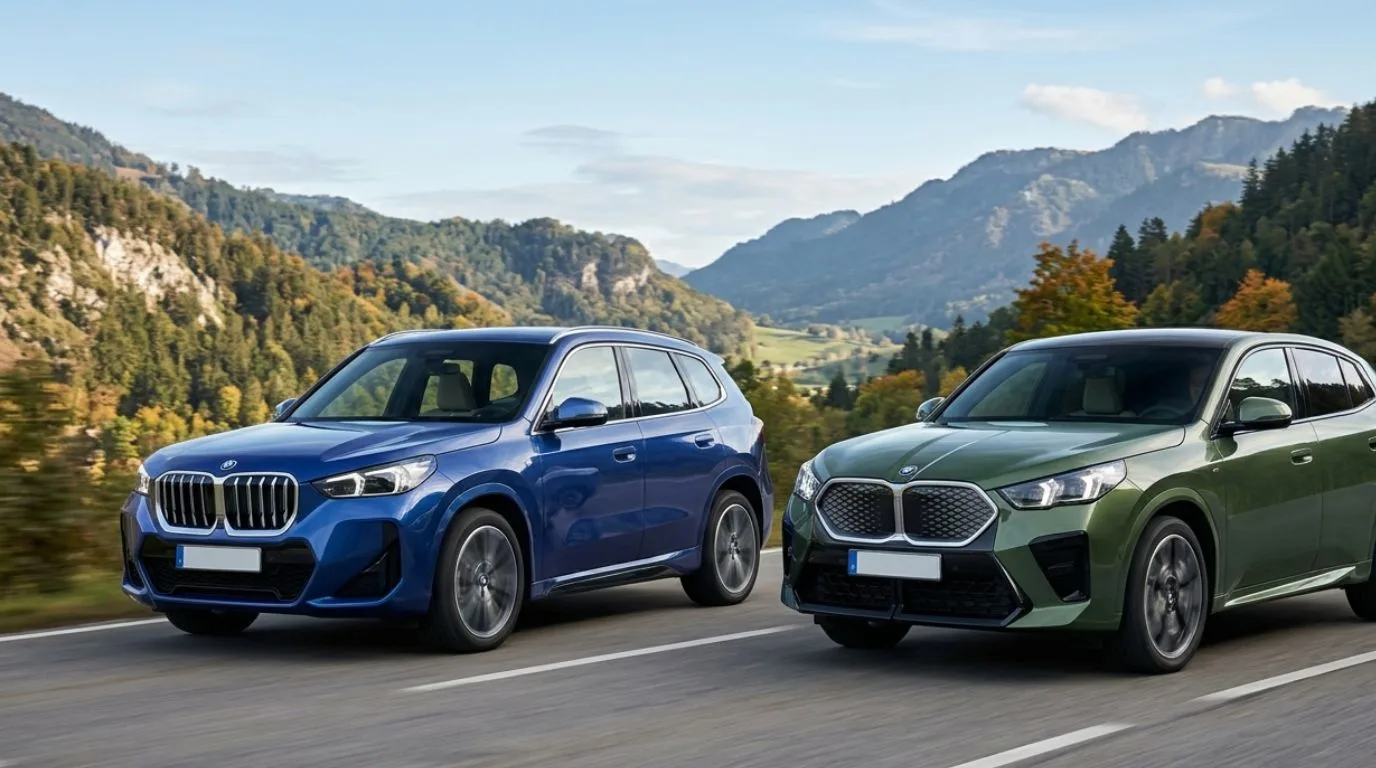
The BMW iX1 and BMW iX2 share the same basic electric-car architecture, battery technology and major powertrain options, but they target slightly different buyers. The iX1 is a traditional compact electric SUV with a taller roof and a more practical overall shape. The iX2 takes a coupe-inspired approach, with a sloping roofline and a sportier exterior design.
Their differences become clearer when you compare luggage capacity, dimensions and electric range. The iX1 offers more maximum luggage space with its rear seats folded, while the iX2 has a larger standard boot capacity. Both provide front-wheel-drive and all-wheel-drive options in the UK market.
For this comparison, UK specifications provide a consistent reference. BMW also announced power electronics updates for both models from spring 2026, improving efficiency and official WLTP range. Specifications and equipment can differ in other countries.
BMW iX2 vs BMW iX1: Key Specifications
| Specification | BMW iX1 | BMW iX2 |
|---|---|---|
| Body style | Electric compact SUV | Electric coupe-style SUV |
| Length | 4,500 mm | 4,554 mm |
| Width | 1,845 mm | 1,845 mm |
| Height | 1,616 mm | 1,560 mm |
| Wheelbase | 2,692 mm | 2,692 mm |
| Standard boot capacity | 490 litres | 525 litres |
| Maximum boot capacity | 1,495 litres | 1,400 litres |
| Battery capacity | 65–65.2 kWh | 65–65.2 kWh |
| Entry-level motor | 204 hp | 204 hp |
| All-wheel-drive version | xDrive30 | xDrive30 |
| Maximum DC charging power | 130 kW | 130 kW |
| DC charging time, 10–80% | Around 29 minutes | Around 29 minutes |
These are UK-market specifications. Battery capacity, range and equipment depend on the selected version.

1. Exterior Design: Traditional SUV vs Coupe Styling
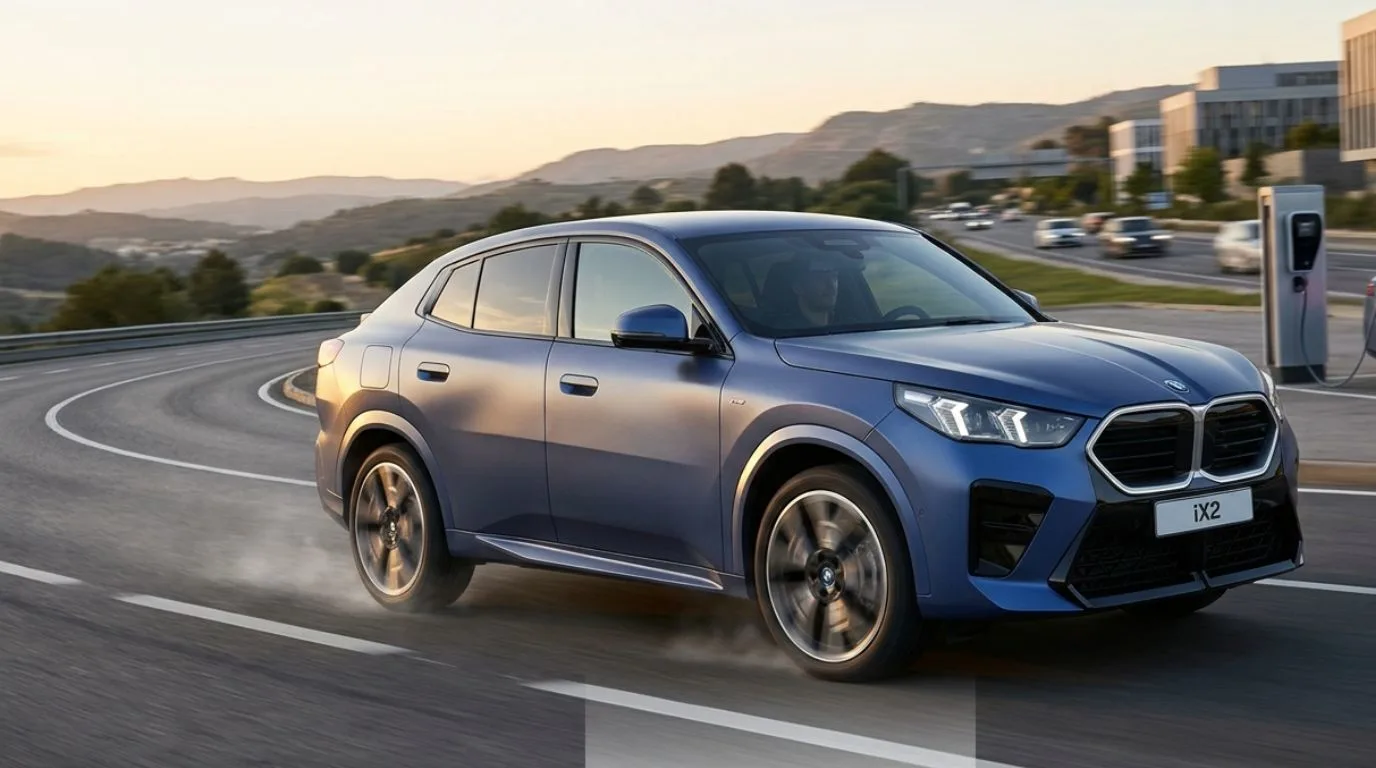
The biggest visual difference between the two electric SUVs is their roofline.
The BMW iX1 follows a conventional SUV design. Its upright body, taller roof and more vertical rear section give it a familiar family-SUV appearance. It has a strong road presence without moving too far away from the traditional compact SUV shape.
The BMW iX2 looks more distinctive. Its coupe-inspired roof slopes towards the rear, creating a lower and sportier profile. The design gives it a different character from the iX1, even though both models share their underlying platform and many exterior design elements.
Their dimensions highlight this difference:
- The iX2 is 54 mm longer than the iX1.
- Both models are 1,845 mm wide.
- The iX1 is 56 mm taller.
- Both have the same 2,692 mm wheelbase.
The extra height of the iX1 is relevant for buyers who value an upright cabin and a more traditional SUV shape. The iX2’s lower roofline is more about styling than additional passenger space.
Design verdict: The iX1 is the practical-looking SUV, while the iX2 is the more distinctive choice for buyers who prefer coupe-inspired styling.
2. Interior Space and Passenger Comfort
The iX1 and iX2 have a similar cabin layout, with BMW’s curved display arrangement and a modern dashboard design. Their infotainment and connected technology are closely related, although the standard and optional equipment can vary by trim and country.
The main difference is the space created by their body shapes.
The iX1’s taller roof gives it a more conventional SUV cabin. This can be useful for passengers who prefer an upright seating environment, particularly in the rear.
The iX2’s sloping roofline gives the exterior a sportier appearance, but it may make the rear cabin feel less accommodating for taller passengers. Buyers who regularly carry adults in the back should check headroom and seating comfort before choosing it.
Both vehicles have the same wheelbase, but that does not mean their interior dimensions are identical. Roof height, seat positioning and body design also influence the available passenger space.
For family use, the iX1 is the more straightforward option. The iX2 is better suited to buyers who are comfortable prioritizing its exterior design over the iX1’s taller body shape.
3. Boot Space: Which BMW Offers More Luggage Capacity?
Boot capacity is an interesting part of the comparison because the iX2 has more standard luggage space, while the iX1 offers more room when the rear seats are folded.
| Luggage capacity | BMW iX1 | BMW iX2 |
|---|---|---|
| Rear seats in use | 490 litres | 525 litres |
| Rear seats folded | 1,495 litres | 1,400 litres |
The iX2 offers 35 litres more standard boot capacity. That gives it an advantage on paper when carrying luggage with all seats in use.
However, the iX1 provides 95 litres more maximum luggage capacity when the rear seats are folded. This can matter when transporting larger items, shopping loads or bulky family equipment.
The figures alone do not describe the complete loading experience. The shape of the boot opening, floor height and the dimensions of individual items also influence how practical a luggage compartment is.
Boot space verdict: The iX2 has the larger standard boot, but the iX1 is more versatile when maximum cargo capacity is needed.
4. BMW iX1 vs iX2: Electric Range and Battery
Both models use BMW’s electric-drive technology and have a battery capacity of approximately 65 kWh. The available versions include the single-motor eDrive20 and dual-motor xDrive30.
BMW announced updated power electronics for the iX1 and iX2 from spring 2026. The use of silicon-carbide semiconductor components in the power electronics helps reduce energy consumption and improve official WLTP range.
The updated maximum ranges announced by BMW are:
| Version | BMW iX1 | BMW iX2 |
|---|---|---|
| eDrive20 | Up to 514 km | Up to 512 km |
| xDrive30 | Up to 466 km | Up to 477 km |
These are maximum WLTP figures announced for the updated models. Actual range depends on the selected equipment, wheels, tires, temperature, road conditions and driving style.
BMW iX1 electric range
The updated iX1 eDrive20 has a maximum announced WLTP range of 514 km. It uses a single electric motor driving the front wheels.
The iX1 xDrive30 uses two electric motors and all-wheel drive. Its announced maximum WLTP range is 466 km.
BMW iX2 electric range
The iX2 eDrive20 has an announced maximum WLTP range of 512 km, putting it very close to the equivalent iX1.
The iX2 xDrive30 has an announced maximum WLTP range of 477 km. In this configuration, the iX2 has a small official range advantage over the iX1 xDrive30.
The difference between the models is therefore not substantial enough to make range the only deciding factor. Buyers should compare equivalent powertrains and the exact specification of the vehicles they are considering.
WLTP is a standardized test procedure. It helps compare vehicles under similar conditions but does not guarantee the same distance in everyday driving.
5. Performance and Motor Options
The BMW iX1 and iX2 offer closely related powertrain choices.
The eDrive20 is the entry-level configuration. It uses one electric motor and front-wheel drive, producing 204 hp and 250 Nm of torque.
The xDrive30 adds a second motor to provide all-wheel drive. BMW lists a nominal output of 306 hp, with a temporary maximum output of up to 313 hp. Maximum torque is 494 Nm.
| Powertrain | BMW iX1 | BMW iX2 |
|---|---|---|
| eDrive20 power | 204 hp | 204 hp |
| eDrive20 torque | 250 Nm | 250 Nm |
| eDrive20 drivetrain | Front-wheel drive | Front-wheel drive |
| xDrive30 nominal power | 306 hp | 306 hp |
| xDrive30 temporary maximum output | 313 hp | 313 hp |
| xDrive30 torque | 494 Nm | 494 Nm |
| xDrive30 drivetrain | All-wheel drive | All-wheel drive |
| xDrive30 0–62 mph | 5.6 seconds | 5.6 seconds |
The eDrive20 is suitable for everyday commuting and general driving. Its front-wheel-drive layout also keeps the powertrain simpler than the dual-motor version.
The xDrive30 is the stronger choice for buyers who want quicker acceleration and all-wheel-drive traction. Both models have similar published performance when equipped with this powertrain.
The xDrive30’s temporary maximum output should not be confused with its nominal power rating. BMW distinguishes between the two figures in its technical specifications.
6. Charging Speed and Convenience
Charging performance is closely matched between the two BMWs.
Both support DC fast charging at up to 130 kW. BMW lists a charging time of approximately 29 minutes for a 10–80% battery charge under suitable conditions.
For AC charging, BMW lists support for up to 11 kW, with 22 kW available depending on the vehicle’s specification and optional equipment.
| Charging detail | BMW iX1 | BMW iX2 |
|---|---|---|
| Maximum DC charging power | 130 kW | 130 kW |
| DC charging time, 10–80% | Around 29 minutes | Around 29 minutes |
| Maximum AC charging power | 11 or 22 kW, depending on specification | 11 or 22 kW, depending on specification |
The stated DC charging time is not guaranteed at every charging station. Battery temperature, charger output, starting battery level and charging conditions affect the actual time.
For home charging, either model can be paired with a compatible wallbox. For longer journeys, their similar DC charging specifications mean neither has a major advantage on paper.
7. Technology, Infotainment and Safety
The iX1 and iX2 share BMW’s modern digital cabin concept. Their curved display arrangement combines the driver’s instrument display and central infotainment screen into one integrated dashboard layout.
Depending on the selected trim and optional equipment, available technology can include:
- BMW Operating System and infotainment functions
- Navigation and connected services
- Smartphone integration
- Voice control
- Digital instrument display
- Parking assistance systems
- Driver-assistance features
The exact equipment list varies by market and trim. Buyers should check the specification of the individual vehicle rather than assuming that every feature is standard on both models.
The same applies to safety equipment and driver assistance. Availability can differ depending on the country, model year and selected package.
8. Price and Availability
BMW iX1 and iX2 prices depend on the country, model year, trim, optional equipment and local taxes. A UK price should not be treated as a global price.
Both models are offered in selected international markets, but their available versions and equipment packages can differ.
For Indian buyers, local availability and specifications should be confirmed through BMW India’s current model range or an authorized dealership. UK-market battery, range and equipment figures should not automatically be applied to an Indian-market vehicle.
A direct price comparison also needs to use equivalent versions. Comparing an entry-level iX1 with a higher-specification iX2 would not provide a fair picture of their relative value.
9. BMW iX2 vs BMW iX1: Which One Should You Buy?
The choice depends on whether practicality or styling matters more.