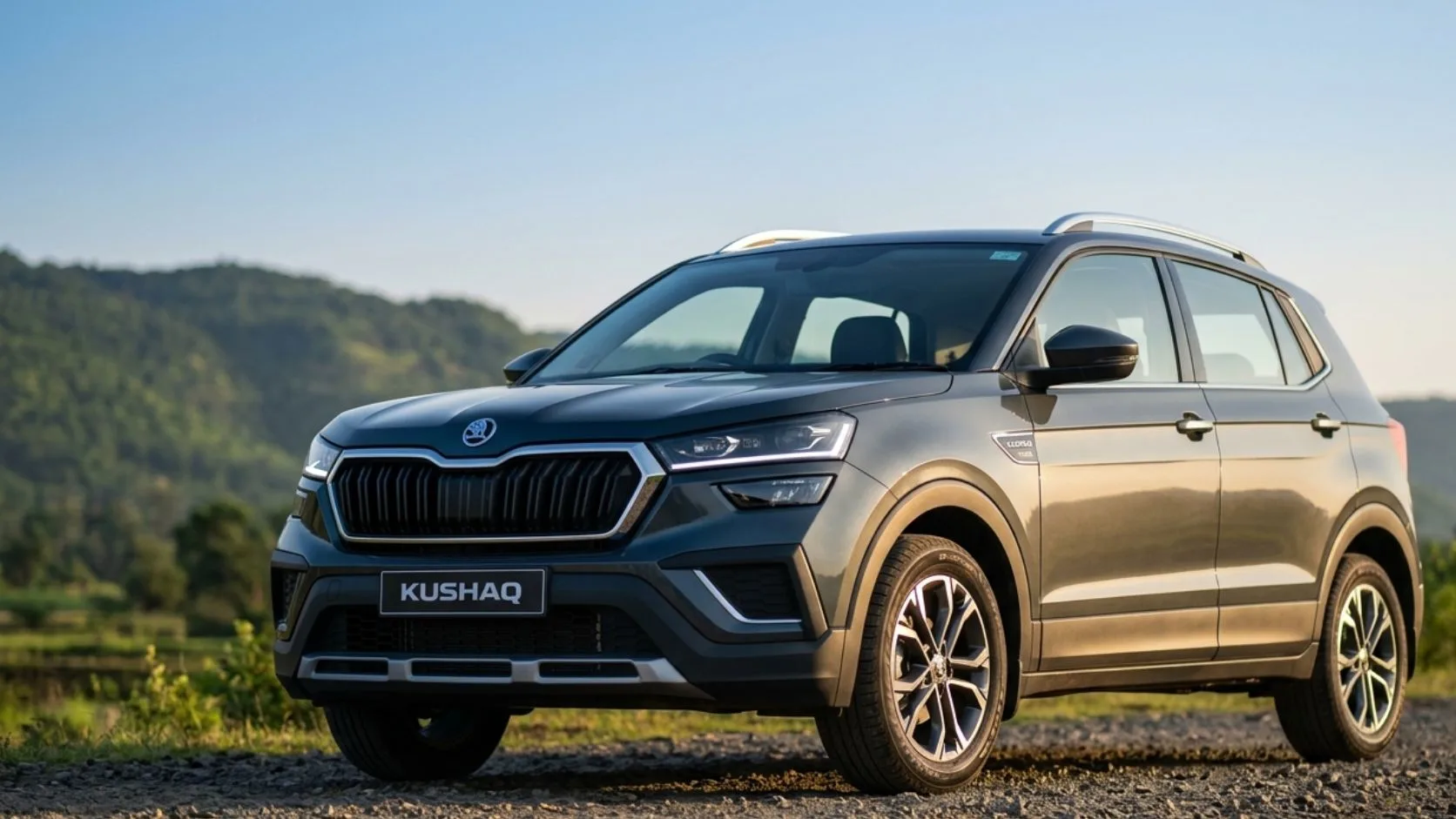
The 2026 Skoda Kushaq is a compact SUV for the Indian market that combines turbocharged petrol engines, a practical five-seat cabin and a chassis tuned for everyday driving. It competes in a crowded segment where buyers compare fuel efficiency, ground clearance, safety equipment, comfort and the convenience of automatic transmissions.
The updated Kushaq brings changes to its exterior styling, cabin equipment and technology while retaining the turbo-petrol approach that distinguishes it from several naturally aspirated petrol rivals. Its available 1.0-liter and 1.5-liter TSI engines serve different needs: the smaller engine is suited to everyday commuting, while the larger unit offers stronger performance.
For buyers, three questions matter most: how much fuel the Kushaq uses in real driving, whether its ground clearance is adequate for Indian roads, and which safety features are included in each variant.
This guide covers the Indian-market 2026 Skoda Kushaq, including its engine options, mileage, safety, ground clearance, features and key buying considerations. Specifications and equipment should be checked against the exact variant available at the time of purchase.

2026 Skoda Kushaq: Key Specifications
| Specification | Details |
|---|---|
| Vehicle segment | Compact SUV |
| Market covered | India |
| Seating capacity | 5 passengers |
| Petrol engine options | 1.0-liter TSI and 1.5-liter TSI |
| Transmission options | Manual and automatic, depending on engine and variant |
| Drivetrain | Front-wheel drive |
| Fuel type | Petrol |
| Ground clearance | 188 mm |
| Main priorities | Everyday usability, turbo-petrol performance and safety equipment |
The Kushaq is a five-seat SUV rather than a three-row family vehicle. Its appeal lies in providing a relatively compact footprint for city driving while retaining the raised seating position and practicality buyers expect from an SUV.
2026 Skoda Kushaq Mileage: How Efficient Is It?
Mileage is one of the main considerations when choosing between the Kushaq’s two petrol engines. The official fuel-efficiency figure depends on the engine and transmission combination, and the advertised number should not be treated as a promise of real-world performance.
The 1.0-liter TSI manual has an ARAI-certified fuel-efficiency figure of up to 19.66 km/l. Actual consumption can be lower in heavy traffic or during frequent short journeys.
The 1.5-liter TSI focuses more on performance, using a larger four-cylinder turbocharged engine. Its fuel consumption will depend on driving conditions, transmission behavior and how frequently the engine is asked to deliver strong acceleration.
What mileage can you expect in everyday driving?
Real-world mileage varies according to several factors:
- City traffic: Stop-and-go driving, long signals and frequent acceleration generally increase fuel consumption.
- Highway journeys: Steady speeds and smooth acceleration can improve fuel efficiency compared with congested urban driving.
- Air conditioning: Heavy cooling demand and extended idling can increase fuel use.
- Driving style: Hard acceleration and high engine speeds generally consume more fuel.
- Vehicle load: Carrying several passengers and luggage can affect efficiency.
For a fair comparison, check the certified mileage of the exact variant you are considering. ARAI figures are useful for comparing vehicles under standardized testing conditions, but they do not guarantee the mileage every owner will achieve.
Which Kushaq engine is better for mileage?
The 1.0 TSI is the sensible starting point for buyers who want a balance of everyday performance and fuel economy. The manual version has the strongest published efficiency figure in the range, while the eight-speed automatic offers greater convenience in traffic.
The 1.5 TSI is better suited to buyers who place a higher priority on acceleration and performance. Its fuel economy should be assessed against its additional power rather than assuming it will match the smaller engine in every situation.
Skoda Kushaq Ground Clearance: Is 188 mm Enough?
The 2026 Kushaq has a maximum ground clearance of 188 mm, according to the manufacturer’s specifications.
Ground clearance is the distance between the road surface and the vehicle’s lowest relevant underbody point under the specified measurement conditions. It matters when driving over speed breakers, uneven roads, broken pavement and raised entrances.
For everyday Indian driving, 188 mm gives the Kushaq useful clearance for dealing with many common road imperfections. However, the outcome depends on vehicle loading, suspension movement, tyre condition and the shape of the obstacle.
How does ground clearance help on Indian roads?
The Kushaq’s ground clearance can be useful when navigating:

- Tall speed breakers and poorly designed road humps
- Uneven village roads
- Broken or patched road surfaces
- Steep parking ramps and driveway entrances
- Potholes and uneven road edges
Drivers should still approach large speed breakers slowly and, where necessary, at an angle that reduces the risk of underbody contact. Ground clearance does not eliminate the possibility of scraping the underside of the vehicle.
Is the Skoda Kushaq an off-road SUV?
The Kushaq is primarily a front-wheel-drive compact SUV designed for paved roads and ordinary road conditions. Its ground clearance helps it handle rough surfaces, but it does not have the dedicated four-wheel-drive hardware offered by some vehicles intended for more demanding off-road use.
It can be suitable for occasional drives on gravel roads or relatively mild uneven tracks, provided the conditions are appropriate. Deep mud, loose sand, rocky trails and steep, slippery inclines require more careful consideration.
Buyers who regularly travel on difficult terrain should evaluate the vehicle’s drivetrain, tyres and underbody protection rather than judging its capability from ground clearance alone.

2026 Skoda Kushaq Engine and Performance
Skoda offers two turbocharged petrol engines in the Indian-market Kushaq. Both send power to the front wheels, but their performance characteristics and transmission options differ.
1.0-liter TSI turbo-petrol engine
The 1.0 TSI is a three-cylinder turbocharged petrol engine producing 115 PS and 178 Nm of torque.
It is designed to provide useful low- and mid-range performance without requiring a larger engine. The turbocharger helps the engine deliver stronger pulling power than a comparable naturally aspirated engine of similar displacement.
The 1.0 TSI is available with a six-speed manual transmission or an eight-speed torque-converter automatic, depending on the variant.
The eight-speed automatic is an important feature of the updated Kushaq. A torque-converter automatic uses a fluid coupling to transfer engine power, which can make it well suited to repeated starts and stops in city traffic.
This engine is worth considering for commuters, small families and buyers who primarily use their SUV for everyday travel and occasional highway trips.
1.5-liter TSI turbo-petrol engine
The larger 1.5 TSI is a four-cylinder turbocharged petrol engine producing 150 PS and 250 Nm of torque.
Its additional power makes it the more performance-oriented choice. It should appeal to drivers who frequently travel on highways, overtake slower vehicles or prefer stronger acceleration when carrying passengers.

The engine uses Active Cylinder Technology, which can deactivate two cylinders under suitable light-load operating conditions to help reduce fuel consumption. The system automatically adjusts cylinder operation according to driving demand.
The 1.5 TSI is paired with a seven-speed DSG dual-clutch automatic transmission in the updated Indian lineup.
A dual-clutch transmission uses two clutches to manage alternating gear sets. It is designed for rapid gear changes, making it a different proposition from the eight-speed torque-converter automatic available with the 1.0 TSI.
Engine comparison
| Specification | 1.0 TSI | 1.5 TSI |
|---|---|---|
| Engine configuration | 3-cylinder turbo-petrol | 4-cylinder turbo-petrol |
| Displacement | 999 cc | 1,498 cc |
| Maximum power | 115 PS | 150 PS |
| Maximum torque | 178 Nm | 250 Nm |
| Transmission options | 6-speed manual, 8-speed automatic | 7-speed DSG automatic |
| Drive type | Front-wheel drive | Front-wheel drive |
| Best suited to | Everyday use and balanced running costs | Buyers prioritizing performance |
The 1.0 TSI offers adequate performance for many daily driving needs, while the 1.5 TSI provides more power and torque. The better choice depends on driving habits, budget and the value placed on acceleration.
2026 Skoda Kushaq Features and Technology
The updated Kushaq adds equipment intended to improve comfort, convenience and the overall cabin experience. One of the important changes is that several features previously associated with higher trims are now included more broadly across the range.
However, some premium equipment remains limited to specific variants.
Exterior design
The updated Kushaq adopts design elements inspired by Skoda’s Modern Solid design language while retaining the model’s familiar compact-SUV proportions.
Its front and rear styling have been revised, giving the vehicle a more contemporary appearance. The Monte Carlo version adds a sportier visual identity for buyers who prefer a more distinctive design.
Standard equipment in the updated lineup includes LED headlamps and taillamps, alloy wheels and an electric sunroof. The precise wheel design, exterior details and other equipment depend on the trim.
Interior and comfort
The cabin combines a practical five-seat layout with a mix of digital technology and comfort features.
Selected equipment includes:
- Climatronic automatic climate control
- Electric sunroof
- Panoramic sunroof on equipped higher variants
- Ventilated front seats
- Six-way electrically adjustable front seats
- Dual-colour ambient lighting
- Rear-seat massage function
- Automatic-dimming interior rear-view mirror
- Rain-sensing wipers
- Rear wiper and rear-window defogger
The rear-seat massage function is a notable addition because it focuses on passenger comfort rather than performance or appearance alone.
As with any feature list, buyers should check which equipment is included in their selected trim. The presence of a feature in the overall model range does not mean that it is available on every version.
Infotainment and connectivity
The updated Kushaq features a 10.1-inch touchscreen infotainment system with wireless Android Auto and Apple CarPlay.
These systems allow compatible smartphones to connect to the vehicle’s infotainment display without requiring a physical cable for supported wireless functions.
The updated model also introduces an AI-powered voice-assistance experience using Google’s automotive AI technology. This is intended to make selected in-car functions and information easier to access through voice commands.
Voice recognition and connected features may depend on software, connectivity, language support and service availability. Drivers should also avoid interacting with infotainment controls while moving if doing so would distract them from the road.
Boot space and practicality
The updated Kushaq offers a claimed boot capacity of 491 liters, expanding to 1,405 liters with the rear seats folded.
This makes the SUV suitable for everyday shopping, airport runs and family trips. Folding the rear seats provides more room for larger items, although doing so reduces the available seating capacity.
For buyers who regularly travel with luggage, it is worth checking the boot’s shape and loading height in person. Published volume figures do not always show how easily a particular suitcase, stroller or bulky item will fit.

Skoda Kushaq Safety: Ratings and Standard Equipment
Safety is one of the Kushaq’s key selling points. The updated Indian model carries forward the nameplate’s five-star Global NCAP safety credentials and adds a substantial set of standard safety equipment.
The original Kushaq achieved five stars for adult and child occupant protection in Global NCAP testing in 2022. That result relates to the vehicle assessed under the applicable test protocol at the time; it should not be presented as a new crash test of the 2026 update.
Which safety features are standard?
The updated Kushaq includes six airbags and more than 25 active and passive safety features as standard, according to Skoda. Higher variants offer more extensive equipment, with the manufacturer citing more than 40 safety features on top-end versions.
Important equipment and technologies include:

- Six airbags
- Electronic stability control
- Anti-lock braking system
- Electronic brakeforce distribution
- Tyre-pressure monitoring system
- Hill-hold control
- Multi-collision braking
- Traction control
- ISOFIX child-seat mounting points
- Rear wiper and defogger
- Rain-sensing wipers
- Automatic-dimming interior rear-view mirror
The exact availability of individual systems should be verified against the variant specification sheet.
How does electronic stability control help?
Electronic stability control, or ESC, helps reduce the risk of a vehicle losing directional control during certain emergency manoeuvres. It can apply braking to individual wheels and manage engine output when the system detects a developing loss of stability.
Hill-hold control helps prevent the vehicle from rolling backward when moving away on an incline. Tyre-pressure monitoring warns the driver when a tyre’s pressure falls below an appropriate threshold.
These technologies support safer driving, but they cannot overcome the limits of tyre grip, excessive speed or poor road conditions.

Is the Kushaq suitable for family use?
The Kushaq offers a five-seat layout, six airbags as standard in the updated range and electronic stability control. These are meaningful considerations for family buyers.
Families should also assess rear-seat child-seat compatibility, visibility, seat-belt access and the ease of getting children in and out. A safety rating is an important reference point, but it does not replace checking the equipment and suitability of the individual vehicle.
2026 Skoda Kushaq Variants and Price in India
Skoda announced the updated Kushaq in India on January 20, 2026, and announced prices and the start of customer deliveries on March 21, 2026.
The updated range includes five principal trims:

- Classic+
- Signature
- Sportline
- Prestige
- Monte Carlo
The entry-level 1.0 TSI range was announced at a starting ex-showroom price of ₹10.69 lakh. The 1.5 TSI DSG version of the Prestige and Monte Carlo trims was announced from ₹18.79 lakh.
These are published launch-price reference points, not a guarantee of the current price for every variant. Prices, offers and availability can change, so buyers should confirm the latest price list with Skoda India or an authorized dealer.
Which variant should you choose?
| Buyer priority | What to consider |
|---|---|
| Lower purchase price | Classic+ |
| Everyday family use | Compare Classic+ and Signature equipment |
| Sportier styling | Sportline or Monte Carlo |
| More comfort and technology | Prestige or Monte Carlo, depending on equipment |
| Stronger performance | 1.5 TSI DSG |
| City driving convenience | 1.0 TSI eight-speed automatic |
| Manual driving preference | 1.0 TSI six-speed manual |
The right trim is the one that provides the features you will actually use without stretching your budget unnecessarily. Compare the complete equipment lists before choosing between variants.
What is the ownership package?
Skoda introduced its Super Care ownership package with the updated Kushaq. The announced package includes a four-year or 100,000-kilometer standard warranty, four years of roadside assistance and four labor-free services for up to two years or 30,000 kilometers.

The manufacturer also announced an option to extend warranty coverage by another two years, taking total coverage up to six years.
Buyers should verify the current warranty terms, service eligibility and exclusions before purchasing, as package conditions may apply.
2026 Skoda Kushaq vs. Other Compact SUVs
The Kushaq competes with models such as the Hyundai Creta, Kia Seltos, Volkswagen Taigun and Maruti Suzuki Grand Vitara in India’s compact-SUV market.
Each approaches the segment differently, so the best choice depends on the buyer’s priorities.
| Model | Main consideration |
|---|---|
| Skoda Kushaq | Turbo-petrol performance, five-seat layout and European-style driving characteristics |
| Volkswagen Taigun | Closely related platform and turbo-petrol powertrain approach |
| Hyundai Creta | Broad range of powertrains, comfort features and variants |
| Kia Seltos | Feature-rich cabin and multiple powertrain choices |
| Maruti Suzuki Grand Vitara | Petrol and hybrid options, with fuel efficiency a key consideration |
The Kushaq and Taigun share important engineering foundations, including their engine family and platform. Their styling, equipment and pricing can differ.
The Creta and Seltos offer alternatives for buyers who prioritize a wide range of cabin features and powertrain choices. The Grand Vitara is worth considering for shoppers interested in a strong emphasis on fuel efficiency, particularly in its hybrid configuration.
A fair comparison should use equivalent variants, transmissions and price categories. Comparing an entry-level manual Kushaq with a fully equipped hybrid rival would not give buyers a useful picture of their relative value.
Advantages and Limitations of the 2026 Skoda Kushaq
Advantages
- Two turbocharged petrol engines with different performance characteristics.
- Up to 188 mm of ground clearance for everyday Indian road conditions.
- Six airbags as standard in the updated range.
- Five-star Global NCAP safety credentials carried forward from the earlier tested model.
- Eight-speed torque-converter automatic available with the 1.0 TSI.
- Seven-speed DSG automatic with the more powerful 1.5 TSI.
- Standard convenience equipment, including an electric sunroof and automatic climate control.
- Useful boot capacity of 491 liters, expandable to 1,405 liters.
Limitations
- No diesel or hybrid powertrain in the Indian lineup discussed here.
- Front-wheel drive rather than a dedicated four-wheel-drive system.
- The 1.5 TSI is paired with the DSG automatic rather than a manual gearbox in the updated range.
- Real-world mileage depends significantly on traffic and driving style.
- Some premium comfort and technology features are restricted to higher variants.
- Five-seat capacity may not suit families that need a third row.
Is the 2026 Skoda Kushaq Worth Buying?
The 2026 Skoda Kushaq is a strong option for buyers seeking a five-seat compact SUV with turbo-petrol performance, useful ground clearance and a well-equipped cabin.
The 1.0 TSI is the more natural choice for everyday commuting and balanced running costs. Its eight-speed automatic is particularly relevant for people who frequently drive in congested cities. The 1.5 TSI is better suited to buyers who want stronger acceleration and are comfortable paying for a more performance-focused powertrain.
The updated model also brings a more extensive standard equipment list, additional cabin comfort features and an expanded infotainment experience. Its ground clearance is useful on ordinary uneven roads, although it should not be confused with the off-road capability of a vehicle designed for difficult terrain.
Before making a decision, compare the exact variant’s price, claimed fuel efficiency, transmission, safety equipment and warranty terms. A test drive should also help you assess ride comfort, rear-seat space, visibility and the way the powertrain behaves in your usual driving conditions.
For buyers who want a petrol-powered compact SUV with a focus on performance and safety, the Kushaq deserves a place on the shortlist.
Frequently Asked Questions
What is the mileage of the 2026 Skoda Kushaq?
The 1.0 TSI manual has an ARAI-certified fuel-efficiency figure of up to 19.66 km/l. Actual mileage depends on the engine, transmission, traffic, road conditions and driving style.
What is the ground clearance of the 2026 Skoda Kushaq?
The updated Kushaq has a maximum ground clearance of 188 mm. This helps with speed breakers and uneven roads, but careful driving is still necessary over large obstacles.
What is the starting price of the 2026 Skoda Kushaq?
The updated 1.0 TSI range was announced in India at ₹10.69 lakh ex-showroom. Buyers should check the current price list for the latest variant prices and offers.
Which engines are available in the 2026 Kushaq?
The Indian lineup includes a 1.0-liter TSI turbo-petrol engine producing 115 PS and 178 Nm, and a 1.5-liter TSI turbo-petrol engine producing 150 PS and 250 Nm.
Does the 2026 Skoda Kushaq have an automatic transmission?
Yes. The 1.0 TSI is available with an eight-speed torque-converter automatic, while the 1.5 TSI is paired with a seven-speed DSG automatic.
Is the 2026 Skoda Kushaq safe?
The updated model includes six airbags and electronic stability control as standard, along with other safety systems. It carries forward the nameplate’s five-star Global NCAP credentials from the earlier model tested in 2022; this should not be interpreted as a new crash-test result for the 2026 update.
Is the Kushaq suitable for rough roads?
Its 188 mm ground clearance is useful for common road imperfections and occasional uneven surfaces. However, the Kushaq is a front-wheel-drive SUV rather than a dedicated off-road vehicle.
Does the 2026 Kushaq have a panoramic sunroof?
Yes, a panoramic sunroof is available on equipped higher variants. Buyers should check the exact trim’s equipment list.
How much boot space does the 2026 Skoda Kushaq offer?
The manufacturer quotes 491 liters of boot space, increasing to 1,405 liters when the rear seats are folded.
Is the 2026 Skoda Kushaq available outside India?
The model covered in this article is the India-market Kushaq. Availability and specifications in other countries should be confirmed with the relevant local Skoda operation.