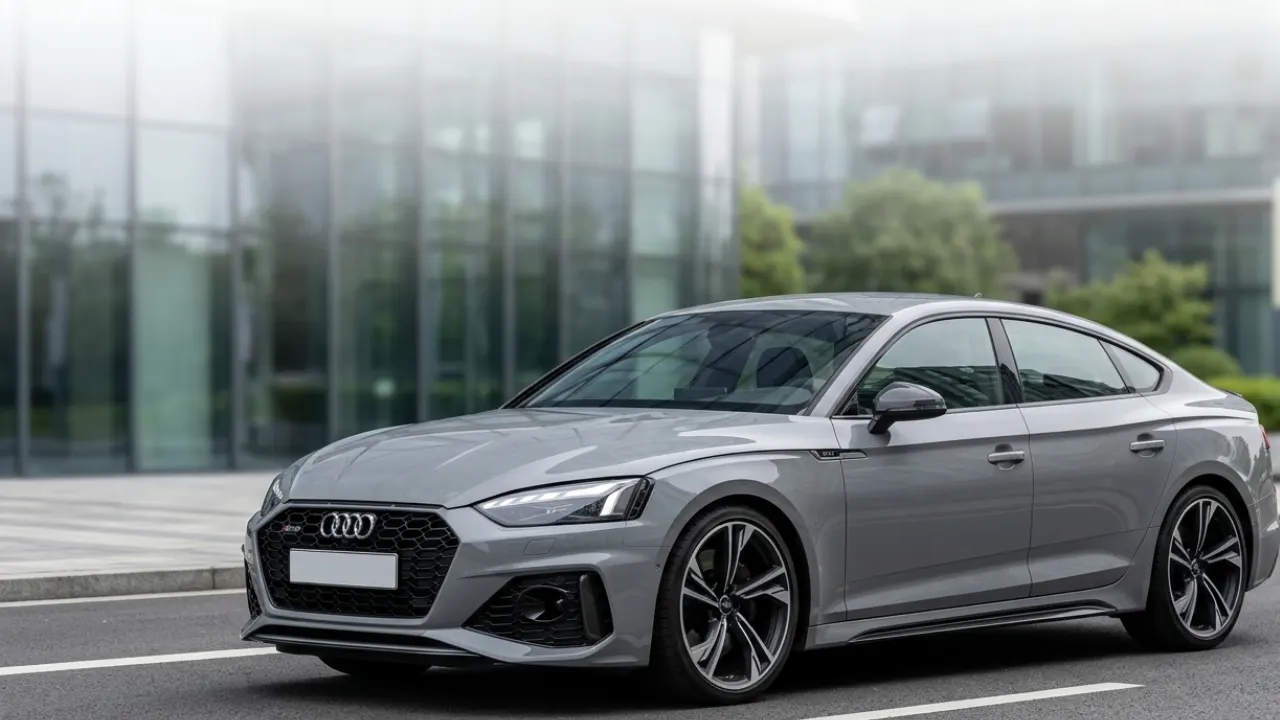
Audi has taken a very different approach with the new RS 5. Instead of relying solely on a high-output combustion engine, the latest performance model combines a 2.9-liter twin-turbocharged V6 with a plug-in hybrid system. The result is Audi Sport’s first high-performance plug-in hybrid, with up to 639 PS of system output and 825 Nm of torque.
There is also a significant change underneath the bodywork. The RS 5 introduces Audi’s new quattro system with Dynamic Torque Control, which uses electromechanical torque vectoring at the rear axle. Audi says the system can distribute torque between the rear wheels in milliseconds, adding another layer of control to the car’s performance-focused chassis.
One important market distinction is worth making at the start: Audi introduced the new RS 5 in 2026 for European markets, while U.S. reporting has identified the American-market car as a 2027 model. U.S. pricing and final specifications had not been officially confirmed in the sources reviewed for this article.
Quick Answer: What’s New on the 2026 Audi RS 5?
The biggest changes are the new plug-in hybrid powertrain, a substantially more powerful system output, and the new rear-axle torque-vectoring technology.
Key confirmed details include:
| Specification | 2026 Audi RS 5 |
|---|---|
| Engine | 2.9-liter twin-turbo V6 |
| V6 output | 510 PS |
| Electric motor | 130 kW / 177 PS |
| System output | Up to 639 PS |
| System torque | 825 Nm |
| Battery | 25.9 kWh gross / 22 kWh net |
| 0–100 km/h | 3.6 seconds |
| Electric range | Up to 84 km EAER |
| City electric range | Up to 87 km |
| Transmission | 8-speed automatic |
| Drive | quattro all-wheel drive |
| Optional top speed | 285 km/h |
| European availability | From the end of June 2026 |
Specifications above are based primarily on Audi’s European-market information and should not be assumed to represent the eventual U.S.-specification vehicle.
Plug-In Hybrid Power Is the RS 5’s Biggest Change
The centerpiece of the new RS 5 is its high-performance plug-in hybrid system.
Audi pairs an updated 2.9-liter twin-turbo V6 producing 510 PS and 600 Nm with a 130-kW electric motor producing 177 PS and 460 Nm. Combined system output reaches as much as 470 kW, or 639 PS, with 825 Nm of system torque.
The electric motor is not simply there to reduce fuel consumption. Its immediate torque also helps the RS 5 respond more quickly from low speeds.
Audi quotes a 0–100 km/h acceleration time of 3.6 seconds. The electric motor can also start the combustion engine, eliminating the need for a conventional 12-volt starter motor for that function.
This makes the RS 5 different from a conventional mild-hybrid performance car. It can actually drive using electric power rather than merely using a small electrical system to assist the engine.
How Much Electric Range Does the RS 5 Have?
The RS 5 uses a 25.9-kWh battery, with 22 kWh of usable capacity. Audi quotes an electric range of up to 84 kilometers under the EAER measurement system, with up to 87 kilometers in city driving.

That figure is based on European testing methodology and should not be converted directly into a U.S. EPA range estimate.
For buyers, the significance is less about turning the RS 5 into an EV and more about giving the car the ability to handle shorter daily trips without necessarily running the V6 continuously.
Audi also allows the driver to manage how the battery is used. Independent testing by Car and Driver reported that the RS 5 can reserve battery energy for later use and offers different driving modes that alter how the combustion engine and electric motor work together.
New quattro Dynamic Torque Control
The RS 5’s other major technical development is its revised quattro drivetrain.
Audi calls the system quattro with Dynamic Torque Control. Unlike a conventional setup that primarily manages front-to-rear torque distribution, this system adds electromechanical torque vectoring across the rear axle.
Audi says the rear system can react in around 15 milliseconds and actively distribute torque between the rear wheels. That can help the car rotate through corners while maintaining traction and stability.
The system is particularly interesting because the torque-vectoring hardware is integrated into a new rear transaxle developed specifically around the hybrid architecture.
In other words, the hybrid system isn’t simply an additional power source. It is deeply integrated into the RS 5’s chassis and drivetrain strategy.
Performance and Driving Character
Audi’s quoted 3.6-second 0–100 km/h time places the new RS 5 firmly in serious performance-car territory. The electric motor provides immediate torque while the twin-turbo V6 supplies sustained power at higher speeds.
The result should make the RS 5 particularly responsive when accelerating from lower speeds.
Independent testing by Car and Driver found the electric motor’s instant torque particularly noticeable during acceleration and reported a 22-kWh battery, while estimating roughly 40 miles of electric range for U.S.-style testing. The publication also reported Audi’s claimed 0–62-mph time of 3.6 seconds.
That distinction matters: the publication’s range estimate is not the same thing as an official EPA rating.
A Performance Hybrid That Is Also Heavy
Adding a large battery and electric motor comes with an obvious trade-off: weight.
Car and Driver reported an Audi-claimed weight of approximately 5,200 pounds for the RS 5 it tested.
That is substantial for a performance sedan or hatchback.
Audi’s answer is not to pretend the weight does not exist. Instead, the RS 5 uses its hybrid hardware as part of the overall chassis strategy, including the rear torque-vectoring system and RS-specific suspension technology.
The result is an interesting engineering approach: rather than simply trying to make a heavy car feel light, Audi is using the electric drivetrain and chassis electronics to improve how that mass is controlled.
RS Sport Suspension
The new RS 5 receives a dedicated RS sport suspension with twin-valve dampers. Audi says the system is designed to respond quickly to changing road conditions while reducing pitch and roll.
This is important because the RS 5 is intended to serve two different roles.
It needs to provide the performance expected from an Audi Sport model, but it also needs to function as an everyday road car.
The combination of adjustable driving modes, adaptive suspension and the plug-in hybrid powertrain gives the driver more control over that balance.
Exterior Design
The new RS 5 receives the visual treatment expected from Audi Sport.
Audi has widened the bodywork and added RS-specific exterior elements, including darker Matrix LED headlights, more aggressive bumpers and an RS sport exhaust system.
The wider stance is not simply cosmetic. The RS-specific bodywork accommodates the hardware required for the car’s performance-oriented chassis and gives the model a clear visual distinction from the regular A5 and S5.
Audi also offers an optional Sport package with exclusive exterior details, 21-inch wheels, an RS sport exhaust system and a higher top-speed limit of 285 km/h.
Interior and Technology
Inside, the RS 5 follows Audi’s newer digital approach while adding RS-specific details.
One notable feature is the 14.5-inch MMI touch display. Audi also offers an Audi driving experience function that can display detailed information about completed drives and, when used at a racetrack, analyze and store sector times.
The RS-focused interface can also provide performance-related information, including data associated with the car’s torque-vectoring and driving modes.
That makes the technology more than a collection of entertainment features. Some of it is specifically designed around understanding how the RS 5 is being driven.
RS 5 Sedan and Avant
Audi is offering the new RS 5 in both Sedan and Avant forms in Europe.
The Avant gives buyers a more practical body style while retaining the same basic high-performance plug-in hybrid architecture. Audi’s official figures list slightly different efficiency and emissions results between the Sedan and Avant, reflecting differences in body configuration and equipment.
The availability of the Avant is particularly relevant to European buyers, where high-performance wagons remain an important part of Audi Sport’s identity.
The U.S. market situation is different. U.S. reporting has described the forthcoming American-market version as a 2027 RS 5, with pricing still to be announced in the sources reviewed.
2026 Audi RS 5 Price and Availability
For Germany, Audi lists the RS 5 Sedan at a starting price of €106,200, while the RS 5 Avant starts at €107,850.
Audi announced that European-market availability would begin from the end of June 2026, with customers able to configure and order the vehicle ahead of that point.
These German prices should not be converted into a U.S. MSRP. Taxes, equipment, market positioning and regulatory requirements differ between countries.
For the United States, the latest reporting reviewed identifies the vehicle as a 2027 Audi RS 5, with U.S. pricing listed as TBD.
Is the Audi RS 5 Coming to the U.S.?
Yes, U.S. reporting indicates that the new RS 5 is planned for the American market, but it is being treated as a 2027 model rather than a 2026 model.
As of the information reviewed for this article, Audi had not published a U.S. MSRP for the new RS 5. That means buyers should avoid relying on European pricing converted directly into dollars.
This is also why the 2026/2027 naming can look confusing in online searches: the same new-generation RS 5 is a 2026 model in European-market material but is expected to arrive in the U.S. as a 2027 model.
Fuel Economy and Efficiency
The RS 5’s plug-in hybrid system gives Audi an opportunity to improve official efficiency figures compared with a conventional high-performance V6.
For the RS 5 Sedan, Audi lists preliminary weighted combined fuel consumption of approximately 4.3–3.8 liters per 100 km and electric consumption of 18.4–17.7 kWh per 100 km under the European WLTP methodology. With the battery discharged, the listed combined fuel consumption is 10.0–9.5 liters per 100 km.
These are WLTP figures, not EPA ratings, and real-world consumption can vary considerably with driving conditions, temperature, speed, battery charge and driving style.
What Makes the New RS 5 Different?
The biggest change isn’t simply the number of horsepower.
The new RS 5 represents a different philosophy for Audi Sport. It combines a large combustion engine, a substantial plug-in battery and sophisticated electric torque management rather than treating electrification as a secondary efficiency feature.
Three technologies define the car:
- 2.9-liter twin-turbo V6 — 510 PS and 600 Nm.
- 130-kW electric motor — adds immediate electric torque.
- Dynamic Torque Control — provides electromechanical rear torque vectoring.
Together, these systems produce up to 639 PS and 825 Nm.
Potential Limitations
The new RS 5 also comes with compromises.

Weight is the most obvious one. The battery and hybrid hardware add considerable mass, and independent testing has highlighted the roughly 5,200-pound figure reported by Audi.
Complexity is another consideration. The RS 5 combines a twin-turbo V6, electric motor, high-voltage battery, multiple differentials, adaptive suspension and extensive electronic controls.
U.S. specifications remain a separate question. European specifications, pricing and WLTP figures should not automatically be applied to the American-market vehicle.
For buyers, the most important unanswered questions will therefore include final U.S. equipment, EPA ratings and U.S. pricing.
2026 Audi RS 5 vs. the Previous RS 5
The new generation changes the RS 5’s formula substantially.
The previous RS 5 relied on a twin-turbo V6 without the new plug-in hybrid system. The latest car adds a large battery and electric motor, increasing total system output while also introducing electric-only driving capability.
The new model also moves to the Dynamic Torque Control rear-axle system, which Audi describes as a world-first production-car application of its electromechanical torque-vectoring approach.
So the major evolution is not simply more power. It is the way Audi uses electrification to influence acceleration, efficiency and handling.
Final Thoughts
The 2026 Audi RS 5 marks a significant shift for Audi Sport. It is the brand’s first high-performance plug-in hybrid, combining a 510-PS twin-turbo V6 with a 130-kW electric motor for up to 639 PS and 825 Nm.
Its new quattro with Dynamic Torque Control is equally important. Rather than adding electrification solely for lower fuel consumption, Audi has integrated the electric system into the RS 5’s performance and handling architecture.
For European buyers, the car is already moving into the market as a 2026 model. U.S. buyers should look toward the 2027 model-year version, with American pricing and final specifications to be confirmed by Audi.
The result is a performance car that attempts to combine three things that traditionally conflict: serious acceleration, electric daily driving and the character of a high-performance V6.

FAQ
Is the 2026 Audi RS 5 a plug-in hybrid?
Yes. The new RS 5 is Audi Sport’s first high-performance plug-in hybrid. It combines a 2.9-liter twin-turbo V6 with a 130-kW electric motor and a 25.9-kWh battery with 22 kWh of usable capacity.
How much horsepower does the new Audi RS 5 have?
The European-market RS 5 produces up to 639 PS of system output, equivalent to about 631 hp using the mechanical horsepower conversion commonly used in the U.S. Its V6 produces 510 PS, while the electric motor produces 177 PS.
How fast is the 2026 Audi RS 5?
Audi quotes 3.6 seconds from 0 to 100 km/h for the new RS 5.
What is the electric range of the Audi RS 5?
Audi quotes up to 84 km of electric range under EAER, including up to 87 km in city driving. These are European figures and should not be treated as an EPA rating.
How much does the Audi RS 5 cost?
In Germany, the RS 5 Sedan starts at €106,200, while the RS 5 Avant starts at €107,850. U.S. pricing for the upcoming American-market version had not been confirmed in the sources reviewed.
Will the Audi RS 5 come to the United States?
U.S. reporting indicates that the new RS 5 is planned for America as a 2027 model, rather than a 2026 model. Final U.S. pricing and specifications should be confirmed by Audi before the vehicle goes on sale.
What engine does the new Audi RS 5 use?
The RS 5 uses a 2.9-liter twin-turbocharged V6 producing 510 PS and 600 Nm, combined with a 130-kW electric motor.
Sources & References
- Audi MediaCenter — The new Audi RS 5: high performance in a hybrid
- Audi MediaCenter — RS 5 powertrain and technical specifications
- Audi MediaCenter — quattro with Dynamic Torque Control
- Audi MediaCenter — RS 5 European availability and engine development
- Audi MediaCenter — Audi Sport model information
- Car and Driver — 2027 Audi RS5 driving review
- Car and Driver — 2027 Audi RS5 reveal and U.S. availability reporting