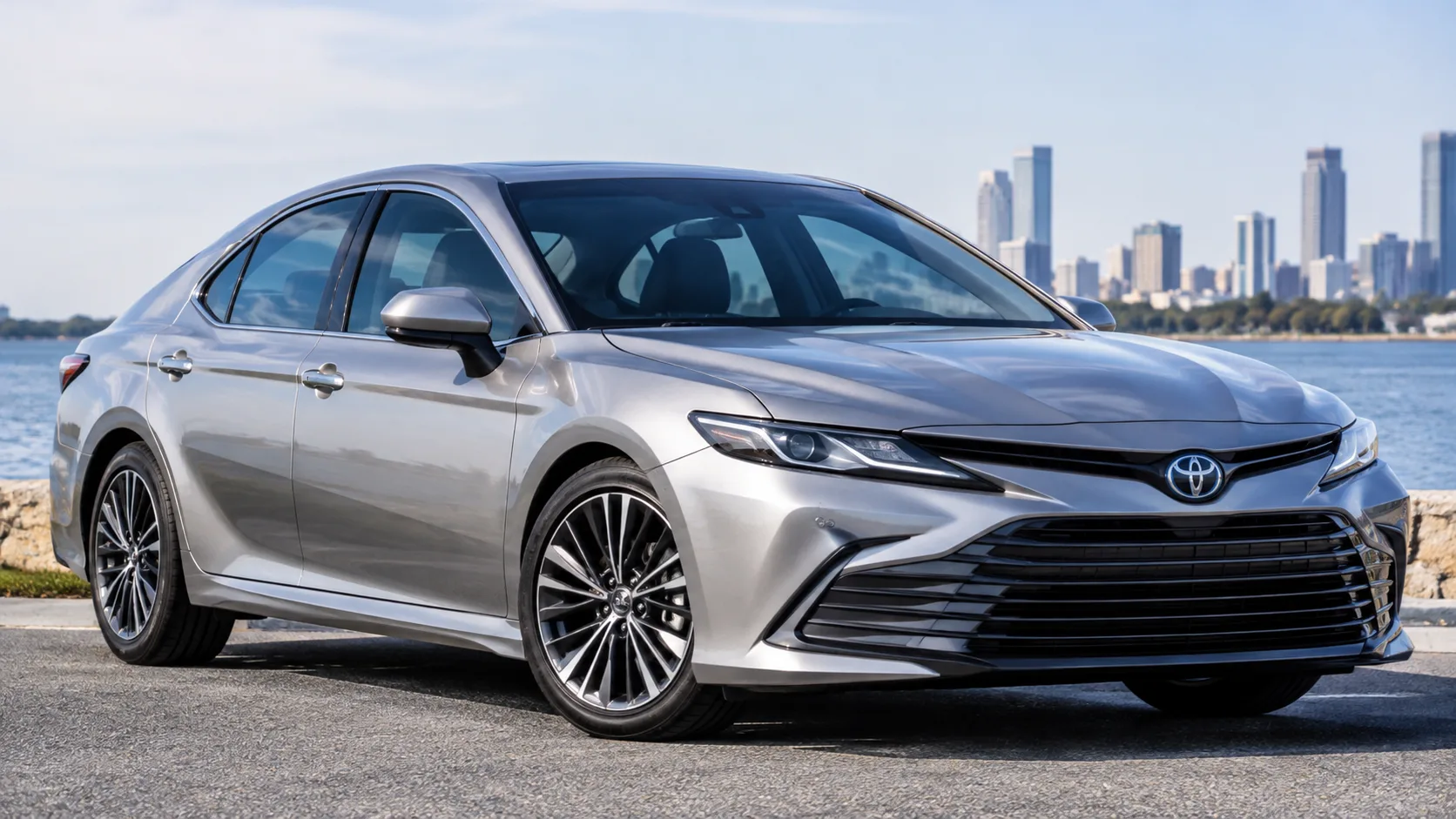
The Toyota Camry Hybrid combines a gasoline engine with an electric motor to reduce fuel consumption, particularly in city traffic. Unlike a plug-in hybrid, it does not need to be connected to an external charger. Its battery recharges through the gasoline engine and regenerative braking.
For buyers, three questions matter most: how much fuel the Camry Hybrid uses in everyday driving, how its hybrid battery works, and whether maintaining the hybrid system costs more than maintaining a conventional gasoline sedan.
The answers depend on the model year and country. This article focuses primarily on the 2025–2026 U.S.-market Camry Hybrid, while noting where specifications and ownership costs differ by market.
Toyota Camry Hybrid real-world mileage: What can owners expect?
For the latest Camry Hybrid sold in India, Toyota advertises an ARAI-certified fuel-efficiency figure of 25.49 km/l. That figure comes from standardized testing, so it should not be treated as a guaranteed result in everyday traffic.

Independent road tests give a more practical picture. Two published tests of the current-generation Indian Camry produced different results, which is a useful reminder that driving routes, traffic, weather and testing methods can affect hybrid mileage.
| Test source | City mileage | Highway mileage | Test average |
|---|---|---|---|
| Autocar India | 16.62 km/l | 23.07 km/l | 19.85 km/l |
| V3Cars (2026 test) | 21.79 km/l | 22.75 km/l | 22.26 km/l |
| Toyota’s certified figure | — | — | 25.49 km/l |
These figures should not be combined into a single guaranteed mileage estimate. The publications used their own test routes and conditions. Autocar India, for example, reported that its city test took place in temperatures reaching 38°C, while V3Cars used a separate tank-to-tank test in Delhi-NCR.
Why does the Camry Hybrid get different mileage in the city and on the highway?
A hybrid powertrain can be particularly efficient in stop-and-go traffic because it can recover some energy while slowing down and use its electric motor at low speeds. The gasoline engine does not need to provide all the power every time the car moves away from a stop.
On highways, the engine generally does more of the work. The Camry can still be efficient at a steady cruising speed, but there are fewer opportunities for regenerative braking than in urban driving.
Real-world fuel economy also depends on:
- Traffic congestion and average speed
- How frequently the driver accelerates hard
- Air-conditioning use and outside temperature
- Tire pressure and tire condition
- Passenger and luggage load
- Road gradients and driving mode
- Vehicle maintenance and hybrid-battery cooling
For an Indian buyer, the published tests suggest that planning around roughly 20–22 km/l in mixed driving is more realistic than assuming the car will always return its certified 25.49 km/l. Actual results can be lower or higher depending on the route and driving style.
How Toyota Camry’s hybrid battery system works
The Indian-market Camry uses Toyota’s fifth-generation hybrid technology. It pairs a 2.5-liter Dynamic Force petrol engine with an electric motor and a lithium-ion traction battery.
The system is a self-charging hybrid, also known as a conventional hybrid electric vehicle (HEV). It does not need to be plugged into a wall charger or public charging station.

The car automatically manages when to use the petrol engine, electric motor or both. The driver does not need to manually switch between the two power sources during normal driving.
Main hybrid-system specifications in India
| Component | Toyota Camry Hybrid |
|---|---|
| Petrol engine | 2.5-liter Dynamic Force, four-cylinder |
| Engine output | 187 PS |
| Engine torque | 221 Nm |
| Combined hybrid-system output | 230 PS |
| Electric motor type | Permanent-magnet synchronous motor |
| Motor output | 136 PS |
| Motor torque | 208 Nm |
| Battery chemistry | Lithium-ion |
| Battery nominal voltage | 251.6V |
| Transmission | e-CVT |
| Drive type | Front-wheel drive |
These are the specifications published by Toyota for the Indian-market model. They should not be assumed to apply to every Camry sold internationally.
1. The petrol engine supplies power when needed
The 2.5-liter engine provides power during acceleration, at higher speeds and whenever the hybrid system determines that the engine is needed. It can also help maintain the battery’s charge.
The engine does not have to run continuously. Depending on speed, battery charge and driving demand, the system can temporarily switch it off.


2. The electric motor assists the engine
The electric motor helps move the car, particularly when starting from a stop and accelerating at lower speeds. When more power is required, the engine and electric motor can work together.
This assistance reduces the amount of work the petrol engine has to do in certain driving conditions. It is one of the main reasons a conventional hybrid can deliver better city fuel economy than a comparable petrol-only vehicle.
3. Regenerative braking recovers energy
When the driver slows down or applies the brakes, the electric motor can operate as a generator. It converts some of the car’s movement energy into electrical energy and sends it to the hybrid battery.
This process is called regenerative braking. It helps recover energy that would otherwise be lost mainly as heat through conventional braking.
Regenerative braking does not recover all the energy used to move the car, but it improves overall efficiency, especially in traffic with frequent slowing and stopping.
4. The system controls battery charging automatically
The Camry’s hybrid system monitors battery charge and power demand. It decides when to use stored electrical energy and when to run the petrol engine.
Owners do not need to follow a manual charging routine. There is no need to install a home charger, and the car cannot be treated like a plug-in hybrid with a large externally rechargeable battery.
How long does the Toyota Camry Hybrid battery last?
Toyota’s hybrid battery is designed to operate as part of the vehicle’s powertrain over many years. However, battery life depends on factors such as age, temperature, usage, cooling and overall vehicle condition.


It is important to separate battery warranty coverage from the battery’s actual service life. A warranty tells buyers how long the manufacturer covers specified faults under its terms; it does not mean the battery will necessarily fail when that period ends.
For the Indian market, Toyota lists hybrid-electric-vehicle battery coverage of 8 years or 1,60,000 km, whichever comes first. The standard new-vehicle warranty listed by Toyota India is 3 years or 1,00,000 km, whichever comes first. Buyers should confirm the warranty booklet and applicable conditions for their specific vehicle.
A U.S.-market Camry has different warranty terms. Toyota’s 2026 U.S. brochure lists 10 years or 150,000 miles for the hybrid battery and 8 years or 100,000 miles for specified hybrid components. These U.S. terms should not be applied to an Indian vehicle.
Does the hybrid battery need regular replacement?
No routine battery replacement interval is specified in the information cited here. The battery is monitored by the vehicle’s hybrid-control system, and it should be inspected if a warning appears or a fault is suspected.

Battery performance can deteriorate over time, but that does not mean every Camry Hybrid will need a replacement after a fixed number of years or kilometres. A vehicle’s age, service history, warning messages and diagnostic results matter more than an assumed universal replacement date.
What affects hybrid-battery health?
The battery’s cooling system is an important part of long-term care. Toyota’s owner guidance explains that blocked battery air-intake vents can restrict cooling, limit battery operation and affect fuel economy.
Owners should therefore:
- Keep the hybrid-battery air-intake area clear.
- Avoid covering the intake vent with seat covers, luggage or other objects.
- Follow the owner’s manual for inspection and cleaning.
- Ask an authorized Toyota workshop to investigate hybrid-system warning messages.
- Avoid attempting repairs to high-voltage components without qualified training.
The exact location and cleaning procedure for the intake vent should be checked in the owner’s manual for the relevant model and market.
Toyota Camry Hybrid maintenance costs: What should owners budget for?
The Camry Hybrid does not require routine charging equipment or the maintenance associated with a plug-in charging system. Its regular servicing still includes many of the same items found on a petrol-powered car, including engine oil, filters, tires, brakes, coolant and the 12-volt electrical system.
The hybrid system adds components that need appropriate inspection, but that does not automatically make every service more expensive. Actual costs depend on the country, workshop, parts prices, labor rates, vehicle age and service requirements.
1. Routine servicing
The petrol engine still needs regular oil and filter changes. Other scheduled work can include inspections of the braking system, tires, suspension, cooling system and other vehicle components.
Toyota India publishes its service and warranty information, but it does not provide one universal lifetime maintenance bill for every Camry owner. The final amount depends on the service interval, parts and consumables required, and the authorized dealer.
2. Hybrid-system inspections
The hybrid battery, inverter, motor-generators and associated electrical components are designed to operate together. They should be checked by technicians familiar with Toyota’s hybrid system.
Owners should not assume that the traction battery requires routine replacement or that every service involves an expensive hybrid-system repair. A repair is generally necessary only when inspection or diagnostic results identify a problem.
3. Hybrid-battery cooling maintenance
The traction battery needs airflow to manage its operating temperature. Dust or obstructions around the intake can affect cooling.
This is a particularly useful maintenance point for vehicles regularly driven in dusty environments or heavy traffic. Follow the cleaning and inspection instructions in the vehicle’s manual rather than using water or applying cleaning products to the intake.

4. Brake maintenance
The Camry uses regenerative braking to recover energy while slowing down. Because the electric motor can help decelerate the car, the friction brakes may be used differently from those in a conventional petrol vehicle.
However, regenerative braking does not eliminate brake wear. Brake pads, discs, brake fluid and the rest of the braking system still require inspection and maintenance according to Toyota’s schedule.
5. Tires, filters and the 12-volt battery
These are ordinary ownership costs that can be easy to overlook when calculating hybrid maintenance expenses.
- Tires: Replacement depends on tire condition, alignment, road surfaces and driving habits.
- Cabin air filter: It may need more frequent attention in dusty or polluted environments.
- Engine air filter: Follow the replacement interval in the service schedule.
- 12-volt battery: This is separate from the high-voltage traction battery and may eventually need replacement.
- Coolant and other fluids: Use the specified fluids and follow the maintenance schedule for the vehicle’s market and model year.
India: Warranty and service information
Toyota India lists the following standard coverage for its vehicles and hybrid batteries:
| Coverage | Published coverage |
|---|---|
| New vehicle warranty | 3 years or 1,00,000 km |
| Hybrid electric vehicle battery | 8 years or 1,60,000 km |
| Service-parts warranty | 6 months or 10,000 km |
| Counter-sale parts warranty | 6 months |
The applicable limit is whichever comes first. Terms and exclusions apply, so owners should check the warranty booklet supplied with their car.
Toyota India also lists free labor for specified maintenance services at authorized dealerships, while lubricants, consumables and parts are chargeable. This means a free service does not necessarily mean that the entire visit will cost nothing.
How much does a Camry Hybrid service cost in India?
There is no single verified service-cost figure that applies to every owner and every service visit. Toyota’s published warranty information does not provide a complete fixed-price schedule for all routine and additional maintenance work.

For an accurate estimate, request a service quotation from an authorized Toyota dealership using the vehicle’s model year, current odometer reading and service history. Ask for labor, parts, lubricants and taxes to be shown separately.
U.S. market: Maintenance coverage is different
For the 2026 U.S.-market Camry, Toyota’s brochure lists ToyotaCare, which covers normal factory-scheduled maintenance for 2 years or 25,000 miles, whichever comes first. It also lists 24-hour roadside assistance for 2 years with unlimited mileage.
That coverage is specific to the U.S. market and should not be confused with Toyota India’s service arrangements. After the included maintenance period, owners should follow the U.S. maintenance guide and obtain local dealer estimates for paid services.
Is the Toyota Camry Hybrid expensive to maintain?
The most responsible answer is that its maintenance costs depend on the vehicle’s market, age and condition. It is not accurate to assume that every hybrid repair will be expensive, but it is equally misleading to claim that a hybrid has no additional maintenance considerations.
For a new Indian-market Camry, the published hybrid-battery warranty provides a defined period of coverage. Regular engine servicing, tires, filters, brakes and other wear-related items still form part of the ownership budget.
For a used Camry Hybrid, a pre-purchase inspection is particularly important. Ask the workshop to check:
- Hybrid-system diagnostic results and warning history
- Traction-battery condition
- Battery cooling intake and related components
- Inverter and cooling-system condition
- Engine and transmission operation
- Service records and warranty eligibility
- Evidence of accident damage or previous high-voltage repairs
A proper inspection is more useful than relying only on the vehicle’s mileage or a seller’s claim that the hybrid battery is in good condition.
How to improve Toyota Camry Hybrid mileage
A hybrid system automatically manages the engine and electric motor, but driving habits still affect fuel consumption.

Accelerate smoothly. Gentle acceleration allows the hybrid system to use electric assistance efficiently. Repeated hard acceleration can increase petrol consumption.
Look ahead in traffic. Gradual slowing gives regenerative braking more opportunity to recover energy. Sudden braking leaves less room for efficient energy recovery.
Maintain tire pressure. Underinflated tires increase rolling resistance and can reduce fuel economy. Use the pressure recommended by Toyota for the vehicle and tire specification.
Avoid unnecessary weight. Carrying heavy luggage or equipment that is not needed increases the energy required to move the car.

Keep the battery intake clear. Follow Toyota’s instructions for inspecting and cleaning the hybrid-battery cooling intake.
Use the appropriate driving mode. Eco mode can help moderate accelerator response and climate-control demand, while Normal mode is suitable for everyday driving. The best mode depends on conditions and driver preference.
Maintain the engine properly. Old engine oil, clogged filters, incorrect tire alignment and neglected maintenance can affect efficiency.
Toyota Camry Hybrid vs a conventional petrol sedan: Ownership considerations
A conventional petrol sedan has a simpler powertrain, while the Camry Hybrid combines an engine, electric motor, traction battery and hybrid-control components.
The hybrid system can reduce petrol consumption, particularly in urban driving. However, buyers should consider the purchase price, local fuel costs, annual mileage, warranty and long-term maintenance when comparing the total cost of ownership.
| Ownership factor | Camry Hybrid | Conventional petrol sedan |
|---|---|---|
| External charging | Not required | Not required |
| City fuel efficiency | Hybrid system can provide an advantage | Depends on engine and driving conditions |
| Highway efficiency | Can be strong at steady speeds | Depends on engine, gearing and vehicle |
| Engine maintenance | Required | Required |
| High-voltage traction battery | Yes | No |
| Regenerative braking | Yes | Usually no |
| Hybrid-system diagnostics | Required when faults are suspected | Not applicable |
| Maintenance costs | Market- and condition-dependent | Market- and condition-dependent |
The hybrid is not automatically cheaper to own in every situation. Buyers who cover high annual distances or spend substantial time in congested traffic may benefit more from its fuel-saving capability than those who drive only occasionally.
Is the Toyota Camry Hybrid worth buying?
The Camry Hybrid makes a strong case for buyers who want a comfortable petrol-electric sedan without needing to charge it externally. Its fuel economy is a major ownership advantage, especially when compared with larger conventional petrol sedans.
For Indian buyers, the published real-world tests are particularly useful. Autocar India’s test returned 19.85 km/l on average, while V3Cars reported 22.26 km/l in its 2026 test. These results show that actual mileage can vary considerably with testing conditions.

The lithium-ion battery and Toyota’s hybrid system are central to the car’s efficiency, but buyers should also understand the battery warranty, cooling requirements and normal service expenses. A hybrid is not maintenance-free; it simply uses a different powertrain strategy.
For someone considering a new Camry, the most useful next step is to compare the purchase price and expected annual fuel savings with the cost of regular servicing. For a used example, a documented service history and a professional hybrid-system inspection should be priorities.
Frequently Asked Questions
1. What is the real-world mileage of the Toyota Camry Hybrid in India?
Published tests of the current Indian-market Camry have reported different results. Autocar India recorded 16.62 km/l in the city and 23.07 km/l on the highway, with a 19.85 km/l test average. V3Cars reported 21.79 km/l in the city and 22.75 km/l on the highway in its 2026 test.
2. What is the official mileage of the Toyota Camry Hybrid in India?
Toyota lists an ARAI-certified fuel-efficiency figure of 25.49 km/l for the latest Indian-market Camry Hybrid. Actual mileage depends on driving conditions and may differ from the certified figure.
3. Does the Toyota Camry Hybrid need to be charged?
No. The Indian-market Camry is a conventional self-charging hybrid. Its battery receives energy through the hybrid system, including regenerative braking and engine operation. It does not need an external charger.
4. What type of battery does the Indian Toyota Camry Hybrid use?
The latest Indian-market Camry uses a lithium-ion hybrid battery. Toyota’s published specifications list a nominal battery voltage of 251.6V.
5. What is the Toyota Camry Hybrid battery warranty in India?
Toyota India lists an 8-year or 1,60,000 km warranty for the high-voltage battery in its hybrid electric vehicles, whichever comes first. The warranty booklet and applicable terms should be checked for the specific car.
6. How long does a Toyota Camry Hybrid battery last?
There is no universal replacement age that applies to every Camry Hybrid. Battery life depends on operating conditions, age, cooling and vehicle maintenance. Warranty duration should not be treated as a guaranteed battery lifespan.
7. Is Toyota Camry Hybrid maintenance expensive?
Not necessarily, but the cost depends on the market, service interval, parts and vehicle condition. Routine petrol-engine servicing remains necessary, and hybrid components should be inspected by trained technicians when required.
8. Does regenerative braking reduce maintenance costs?
Regenerative braking can reduce how much the conventional friction brakes are used in some driving conditions. However, brake pads, discs and brake fluid still require inspection and maintenance.
9. Can the Toyota Camry Hybrid run only on electric power?
It can operate on electric power in certain low-speed and light-load conditions, depending on battery charge and system requirements. It is not designed to operate like a battery-electric vehicle for extended journeys.
10. Is the U.S. Toyota Camry Hybrid the same as the Indian model?
No. Specifications, power output, fuel-economy ratings, available trims, equipment and warranty coverage can differ by market. Buyers should use the official Toyota information for the country where the vehicle is sold.

Final Thoughts
The Toyota Camry Hybrid’s main ownership advantage is its ability to combine petrol-engine practicality with electric-motor assistance. In India, its certified mileage is 25.49 km/l, but independent tests show that real-world results can vary depending on traffic, weather and driving conditions.
Its lithium-ion battery does not require external charging, and Toyota India lists an 8-year or 1,60,000 km hybrid-battery warranty. Regular engine servicing and other routine maintenance remain necessary, while hybrid-system checks should be handled by qualified technicians.
For buyers, the sensible approach is to evaluate the Camry using realistic fuel-economy expectations, the warranty applicable to their market and an authorized dealer’s service quotation rather than relying on a single mileage claim or an assumed battery replacement cost.