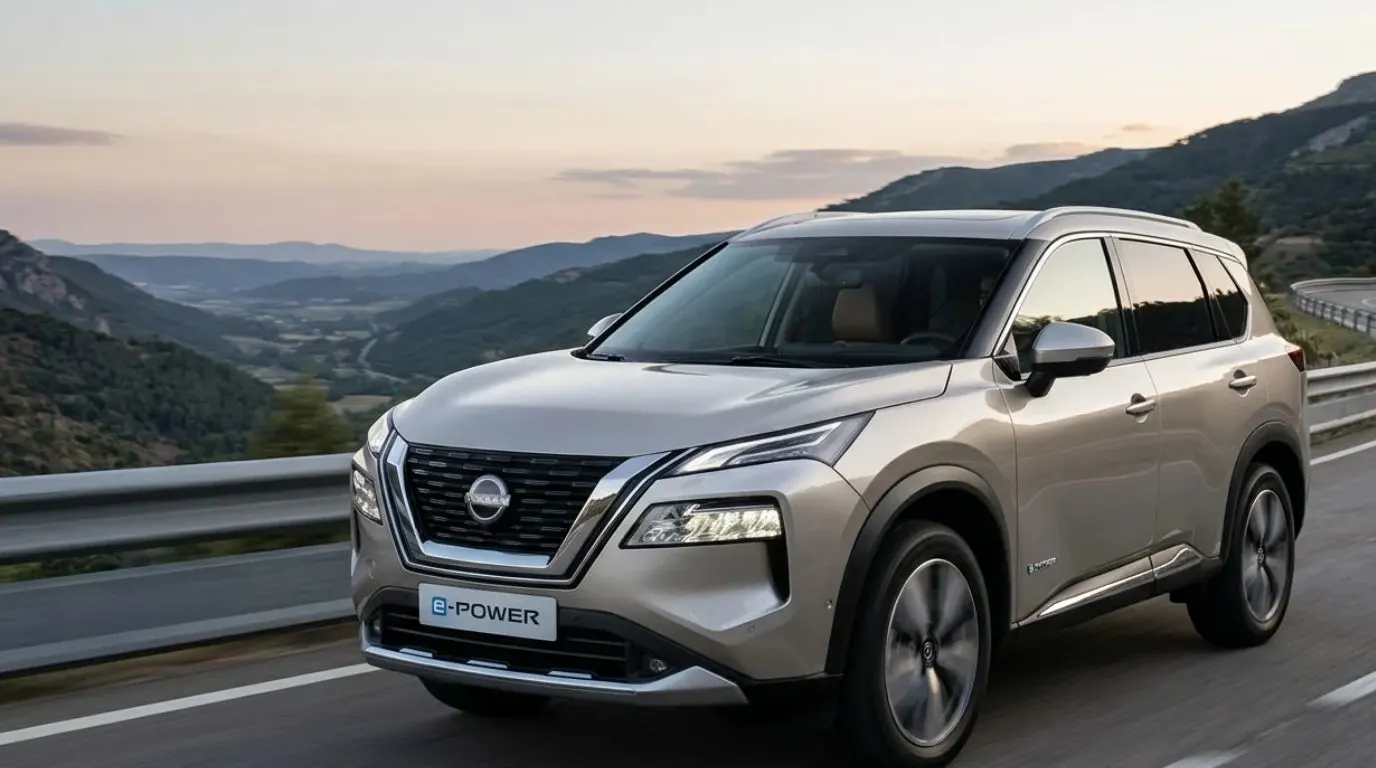
The Nissan X-Trail e-POWER takes a different approach to hybrid technology. Unlike conventional hybrids, where a petrol engine and an electric motor can both drive the wheels, Nissan’s e-POWER system uses an electric motor exclusively for propulsion. The petrol engine generates electricity, while a battery stores and supplies energy to the motor.
The result is an SUV that delivers an electric-vehicle-like driving experience without requiring an external charging connection. Drivers can refuel at a conventional petrol station while benefiting from electric-motor acceleration, regenerative braking and quieter low-speed operation.
For buyers considering a hybrid family SUV, the X-Trail e-POWER raises some important questions. How does its unusual hybrid system work? How much fuel does it consume? Does it feel like an electric vehicle behind the wheel? And is it more practical than a conventional hybrid or a fully electric SUV?
Here is a closer look at its technology, fuel economy, performance and everyday driving characteristics.

Nissan X-Trail e-POWER: Quick Overview
The Nissan X-Trail e-POWER is a petrol-powered series hybrid SUV. Its wheels are driven by electric motors, while a petrol engine acts as an onboard electricity generator.
Unlike a plug-in hybrid, it does not need to be connected to a charging station. The battery receives electricity from the petrol engine and regenerative braking.
The available powertrain and fuel economy depend on the market and drivetrain configuration.
For reference, Nissan Australia’s current X-Trail specifications list the following figures:

| Specification | X-Trail e-POWER |
|---|---|
| Hybrid system | Nissan e-POWER |
| Petrol engine | 1.5-litre, three-cylinder |
| Engine function | Electricity generation |
| Front electric motor | 150 kW |
| Front motor torque | 330 Nm |
| Rear electric motor (e-4ORCE) | 100 kW |
| Rear motor torque | 195 Nm |
| Drivetrain options | FWD and e-4ORCE AWD |
| Transmission | Automatic electric-drive system |
| External charging | Not required |
| Fuel consumption (FWD) | 5.3 L/100 km |
| Fuel consumption (AWD) | 6.1 L/100 km |
These are Australian-market specifications. Equipment, powertrain availability and efficiency figures differ between countries and model configurations.
What Is Nissan e-POWER Technology?
Nissan e-POWER is a hybrid powertrain designed to deliver electric-motor driving without depending on an external charging connection.
It combines three main elements:
- A petrol engine that generates electricity.
- A lithium-ion battery that stores electrical energy.
- An electric motor that drives the wheels.
The important difference is how these components work together.
In a conventional parallel hybrid, the petrol engine can directly drive the wheels, while an electric motor assists when necessary. Some systems can also operate using electric power alone.
Nissan e-POWER follows a different arrangement. The electric motor provides the driving force at the wheels. The petrol engine is used to generate electricity rather than mechanically powering the wheels.
This arrangement is why Nissan describes e-POWER as delivering an EV-like driving experience.
It also means the driver does not need to manage charging sessions or search for public charging infrastructure.

How Does the Nissan X-Trail e-POWER Hybrid System Work?
Understanding the technology becomes easier when looking at what happens during a normal journey.
1. The Petrol Engine Generates Electricity
The X-Trail uses a 1.5-litre, three-cylinder petrol engine as part of its e-POWER system.
Rather than directly driving the wheels, the engine operates as an electricity generator.
It produces power that can supply the electric motor and recharge the battery when necessary.

Nissan’s system can control when the engine operates according to factors such as vehicle speed, acceleration demand and battery charge level.
2. The Battery Stores Electrical Energy
The electricity generated by the petrol engine can be stored in a lithium-ion battery.
This battery acts as an energy buffer between the generator and the electric motor.
It can supply electricity when the vehicle needs additional power, including during acceleration.
The battery also receives energy through regenerative braking.
3. The Electric Motor Drives the Wheels
This is the defining feature of e-POWER.
The electric motor is directly responsible for driving the wheels. It delivers torque without waiting for a conventional engine to build up power through changing engine speeds.
The result is responsive acceleration, particularly when moving away from a standstill or travelling at lower speeds.
4. Regenerative Braking Recovers Energy
The X-Trail also uses regenerative braking to recover some energy when slowing down.
During deceleration, the electric motor can operate as a generator, converting some of the vehicle’s movement into electrical energy.
That electricity is returned to the battery.
Regenerative braking does not eliminate the need for conventional brakes, but it helps reduce energy losses during everyday driving.

Nissan e-POWER vs Conventional Hybrid vs Electric Vehicle
Although e-POWER shares characteristics with electric vehicles and conventional hybrids, its operating system is different.
| Feature | Nissan e-POWER | Conventional Hybrid | Full EV |
|---|---|---|---|
| Petrol engine | Yes | Usually yes | No |
| Electric motor | Yes | Yes | Yes |
| Motor drives wheels | Yes | Depending on system | Yes |
| Engine directly drives wheels | No | Often yes | No |
| External charging | Not required | Not required | Required |
| Petrol refuelling | Yes | Yes | No |
| Regenerative braking | Yes | Yes | Yes |
The biggest advantage of e-POWER is that it provides electric-motor propulsion without requiring owners to change their refuelling habits.
However, it is not a zero-emission electric vehicle. It still burns petrol to generate electricity and produces exhaust emissions.
Nissan X-Trail e-POWER Engine and Motor Specifications
The X-Trail e-POWER combines a petrol generator with electric-drive hardware.
In the Australian-market version, the system uses a 1.5-litre, three-cylinder petrol engine alongside electric motors.
The front-wheel-drive version uses a 150 kW front electric motor with 330 Nm of torque.
The e-4ORCE all-wheel-drive version adds a rear electric motor rated at 100 kW and 195 Nm.
These motor outputs should not simply be added together and treated as the vehicle’s total system output. Combined system power is a separate manufacturer-rated figure.
What Is the Role of the 1.5-Litre Engine?
The petrol engine is not responsible for conventional mechanical propulsion.
Instead, its main job is to produce electricity.
Nissan uses variable compression ratio technology in the X-Trail’s VC-Turbo engine configuration. This allows the engine to adjust its compression ratio according to operating requirements.
The technology is intended to balance power generation, efficiency and refinement.
Because the engine is not mechanically connected to the driving wheels, its operating speed does not have to follow the vehicle’s speed in the same way as a conventional petrol engine.
This gives Nissan greater flexibility in managing engine operation.
Nissan X-Trail e-POWER Mileage: How Efficient Is It?
Fuel economy is one of the most important considerations for anyone considering a hybrid SUV.
The X-Trail e-POWER is designed to combine electric-motor driving with petrol-powered electricity generation. However, its actual fuel consumption depends on the vehicle configuration and driving conditions.

Nissan Australia’s published combined-cycle figures provide a useful market-specific reference.
| Version | Official Combined Fuel Consumption |
|---|---|
| X-Trail e-POWER FWD | 5.3 L/100 km |
| X-Trail e-POWER e-4ORCE AWD | 6.1 L/100 km |
These figures are manufacturer-published Australian-market specifications, not guaranteed real-world mileage.
For easier comparison, the figures can be expressed as approximately:
- FWD: 18.9 km per litre.
- AWD: 16.4 km per litre.
These are mathematical conversions of the published consumption figures, not separate official mileage ratings.

What Affects Real-World Fuel Economy?
Several factors can influence the X-Trail’s actual fuel consumption.
Driving style: Frequent hard acceleration requires more energy and can increase petrol consumption.
Traffic conditions: Stop-start traffic creates opportunities for regenerative braking, but prolonged idling and repeated acceleration can still affect efficiency.
Highway speed: Higher sustained speeds increase aerodynamic resistance and can change how frequently the engine needs to generate electricity.

Air conditioning: Climate-control use increases the vehicle’s energy requirements.
Vehicle load: Carrying passengers, luggage or additional equipment can increase energy consumption.
Weather and road conditions: Cold temperatures, steep gradients and difficult driving conditions can affect hybrid efficiency.
Is e-POWER More Efficient in City Driving?
Electric motors can be particularly useful in urban conditions because they provide immediate torque and can recover energy during deceleration.
The X-Trail can therefore benefit from the repeated slowing and acceleration associated with city journeys.
However, it would be inaccurate to claim that every city journey will produce better fuel economy than every highway journey.
The result depends on traffic, speed, temperature, driving style and other operating conditions.
Nissan X-Trail e-POWER Driving Experience
The main purpose of Nissan’s e-POWER system is to make the X-Trail feel more like an electric vehicle when accelerating and driving.

There are several characteristics worth understanding.
Immediate Electric-Motor Response
One of the defining characteristics of electric motors is their ability to deliver torque quickly.
The X-Trail benefits from this characteristic when moving away from a standstill.
Rather than relying on conventional engine revs and transmission shifts to build acceleration, the electric motor provides the driving force.
This can make the vehicle feel responsive in urban traffic and during ordinary acceleration.
Smooth Acceleration
Because the electric motor drives the wheels, acceleration does not follow the same pattern as a traditional petrol SUV with multiple gear changes.
The result is a smoother power delivery experience.
There is no conventional stepped gear shifting involved in delivering propulsion through the electric motor.

However, the petrol engine can still become audible when it starts generating electricity, particularly when the vehicle needs more power.
Engine Noise and Cabin Refinement
One common expectation from hybrid technology is quieter operation.
The X-Trail e-POWER can operate using stored electrical energy and electric-motor propulsion in situations where engine generation is not required.
When the petrol engine starts, its noise can be heard inside the cabin.
Nissan manages engine operation through its power-generation control system, including strategies designed to reduce unnecessary engine starts and make engine operation less noticeable.
Nevertheless, e-POWER should not be confused with a fully electric vehicle that has no combustion engine.
e-Pedal Step Driving
Selected X-Trail e-POWER versions also offer Nissan’s e-Pedal Step technology.
It allows the driver to control acceleration and deceleration more naturally through the accelerator pedal.
When the driver releases the accelerator, the system applies regenerative deceleration.
The brake pedal remains necessary for stronger braking and bringing the vehicle to a complete stop.
This feature can be useful in traffic because it reduces the need to move constantly between the accelerator and brake pedals.
Its availability and operating characteristics depend on the market and version.

What Is Nissan e-4ORCE All-Wheel Drive?
The Nissan X-Trail e-POWER is also available with e-4ORCE electric all-wheel-drive technology in selected markets.
Unlike a conventional mechanical AWD arrangement, e-4ORCE uses electric motors to control power delivery to the front and rear wheels.
In the Australian-market X-Trail configuration, the system combines:
- A 150 kW front electric motor.
- A 100 kW rear electric motor.
- Electronic control of front and rear motor output.
The system manages torque distribution to improve traction and vehicle stability.
It can also coordinate motor operation with braking control to help manage body movement during acceleration and deceleration.
Benefits of e-4ORCE
The main advantages include:
- Improved traction on slippery surfaces.
- More controlled acceleration.
- Electric power delivery to both axles.
- Better management of vehicle movement during cornering.
- Additional capability on suitable loose or uneven surfaces.
However, e-4ORCE does not turn the X-Trail into a dedicated off-road vehicle.
Tyres, ground clearance, suspension design and driving conditions remain important limitations.

Nissan X-Trail e-POWER Interior and Practicality
The X-Trail is positioned as a family-oriented midsize SUV.
Its cabin focuses on passenger comfort, technology and everyday practicality rather than delivering an entirely different interior for its hybrid powertrain.
Equipment depends on the market and trim level.
The Australian-market model includes features such as a 12.3-inch infotainment touchscreen, wireless Apple CarPlay and Android Auto, and an available 12.3-inch digital instrument display.
Higher-specification versions also offer additional equipment, including a 10.8-inch head-up display and premium interior finishes.
The e-POWER models in Australia are offered as five-seat configurations.
This is worth checking before purchasing because some conventional petrol X-Trail versions in that market offer seven seats.
For families, seating configuration and luggage space may be just as important as fuel economy.
The Australian-market brochure lists 575 litres of luggage capacity for the five-seat e-POWER configuration, measured to the roof line with the second row upright.
Buyers should check the corresponding specification for their local market rather than assuming that all X-Trail versions have identical interior dimensions and storage capacity.
Nissan X-Trail e-POWER vs Conventional Petrol X-Trail
The X-Trail is available with different powertrain configurations in some markets.
Choosing between the petrol and e-POWER versions depends on how the vehicle will be used.
| Factor | X-Trail Petrol | X-Trail e-POWER |
|---|---|---|
| Main power source | Petrol engine | Electric motor |
| Petrol engine drives wheels | Yes | No |
| Electric motor propulsion | No dedicated e-POWER drive system | Yes |
| External charging | Not required | Not required |
| Driving response | Conventional petrol characteristics | Electric-motor response |
| Fuel economy | Depends on engine and drivetrain | Depends on e-POWER configuration |
| Transmission | Conventional CVT in Australian petrol versions | Electric-drive automatic system |
| AWD availability | Market-dependent | e-4ORCE in selected versions |
The conventional petrol version may appeal to buyers who prefer a familiar powertrain and want access to available seating configurations.
The e-POWER version may be more attractive to drivers who value electric-motor acceleration and want hybrid technology without plug-in charging.
The final decision should also account for purchase price, servicing arrangements, warranty coverage and local fuel costs.
Nissan X-Trail e-POWER: Advantages and Limitations
The e-POWER system offers a distinctive combination of electric propulsion and petrol-powered energy generation.

However, it is not automatically the best option for every SUV buyer.
Advantages
Electric-motor driving: The electric motor provides responsive acceleration and smooth power delivery.
No external charging: Owners can refuel using petrol without depending on charging infrastructure.
Regenerative braking: The system recovers some energy during deceleration.
Flexible engine operation: The petrol engine can generate electricity without being mechanically tied to vehicle speed.
Available electric AWD: e-4ORCE provides additional traction capability in selected versions.
Familiar refuelling: Drivers do not need to plan their journeys around public charging stations.
Limitations
Still uses petrol: Despite its electric-motor propulsion, the vehicle relies on petrol for electricity generation.
Engine noise remains: The petrol engine can become audible when generating electricity.
No conventional plug-in EV operation: It cannot be treated as a fully electric vehicle with externally rechargeable driving range.
Fuel consumption varies: Real-world efficiency depends on speed, traffic, climate and driving conditions.
Market-specific availability: Powertrain options, seating arrangements and equipment differ by country.
Higher powertrain complexity: The system combines a petrol engine, generator, battery and electric-drive components.
Is the Nissan X-Trail e-POWER Worth Considering?
The X-Trail e-POWER is worth considering for buyers who want the driving characteristics of an electric motor without moving to a fully electric vehicle.
Its biggest appeal is the combination of electric-motor propulsion and conventional petrol refuelling.
It may be particularly suitable for:
- Families looking for a hybrid midsize SUV.
- Drivers who regularly travel in urban traffic.
- Buyers who appreciate responsive electric-motor acceleration.
- People who do not have convenient access to home or public charging.
- Drivers who want an electrified AWD option in selected markets.
However, buyers who want zero tailpipe emissions while driving should consider a fully electric vehicle instead.
Similarly, anyone prioritising maximum passenger capacity should check whether their local e-POWER version offers the required seating arrangement.
Final Thoughts
The Nissan X-Trail e-POWER is an interesting alternative to conventional hybrid SUVs because its electric motor is responsible for driving the wheels, while the petrol engine generates electricity.
This arrangement delivers an EV-like driving experience without requiring external charging.

Its main attractions are responsive acceleration, smooth power delivery, regenerative braking and the availability of e-4ORCE electric all-wheel drive.
Fuel economy is another important consideration. Nissan Australia’s published figures range from 5.3 L/100 km for the front-wheel-drive version to 6.1 L/100 km for the e-4ORCE AWD version. Actual consumption can differ depending on driving conditions.
The technology is not a replacement for a fully electric vehicle, but it offers a practical middle ground for buyers who want electric-motor driving while retaining petrol refuelling convenience.
For anyone considering the X-Trail, the most important decision is whether the benefits of e-POWER match their driving habits, budget and passenger requirements.
Frequently Asked Questions
1. How does the Nissan X-Trail e-POWER work?
The Nissan X-Trail e-POWER uses a petrol engine to generate electricity, which is stored in a battery and supplied to an electric motor. The electric motor drives the wheels, rather than the petrol engine directly powering them.
2. Does the Nissan X-Trail e-POWER need charging?
No. The X-Trail e-POWER does not require an external charging connection. Its battery receives electricity from the petrol-powered generator and regenerative braking.
3. What is the Nissan X-Trail e-POWER mileage?
For the Australian-market model, Nissan publishes combined fuel consumption of 5.3 L/100 km for the FWD version and 6.1 L/100 km for the e-4ORCE AWD version. Real-world fuel consumption can vary.
4. Does the X-Trail e-POWER run on petrol?
Yes. It uses a petrol engine to generate electricity. Although the wheels are driven by electric motors, petrol remains necessary for normal operation.
5. Is Nissan e-POWER the same as a conventional hybrid?
No. In a conventional parallel hybrid, the petrol engine and electric motor can both drive the wheels. In Nissan’s e-POWER system, the electric motor exclusively drives the wheels, while the petrol engine generates electricity.
6. Does the Nissan X-Trail e-POWER have an electric driving mode?
The vehicle can operate using stored battery energy and electric-motor propulsion when conditions allow. However, it is not a plug-in hybrid with a separately specified externally rechargeable electric driving range.
7. What is Nissan e-4ORCE?
e-4ORCE is Nissan’s electric all-wheel-drive technology. It uses front and rear electric motors with electronic control to manage power delivery and improve traction and vehicle stability.
8. Is the Nissan X-Trail e-POWER available with seven seats?
This depends on the market. In Australia, the e-POWER versions are five-seat models, while certain conventional petrol versions offer seven seats. Buyers should check their country’s official specifications.
9. Is the Nissan X-Trail e-POWER a fully electric SUV?
No. It uses electric motors to drive the wheels, but a petrol engine generates electricity. It is a series hybrid rather than a battery-electric vehicle.
10. Is the Nissan X-Trail e-POWER suitable for long-distance driving?
It can be used for long-distance journeys without relying on public charging stations because it carries petrol and generates its own electricity. Fuel consumption will depend on highway speed, road conditions, vehicle load and driving style.