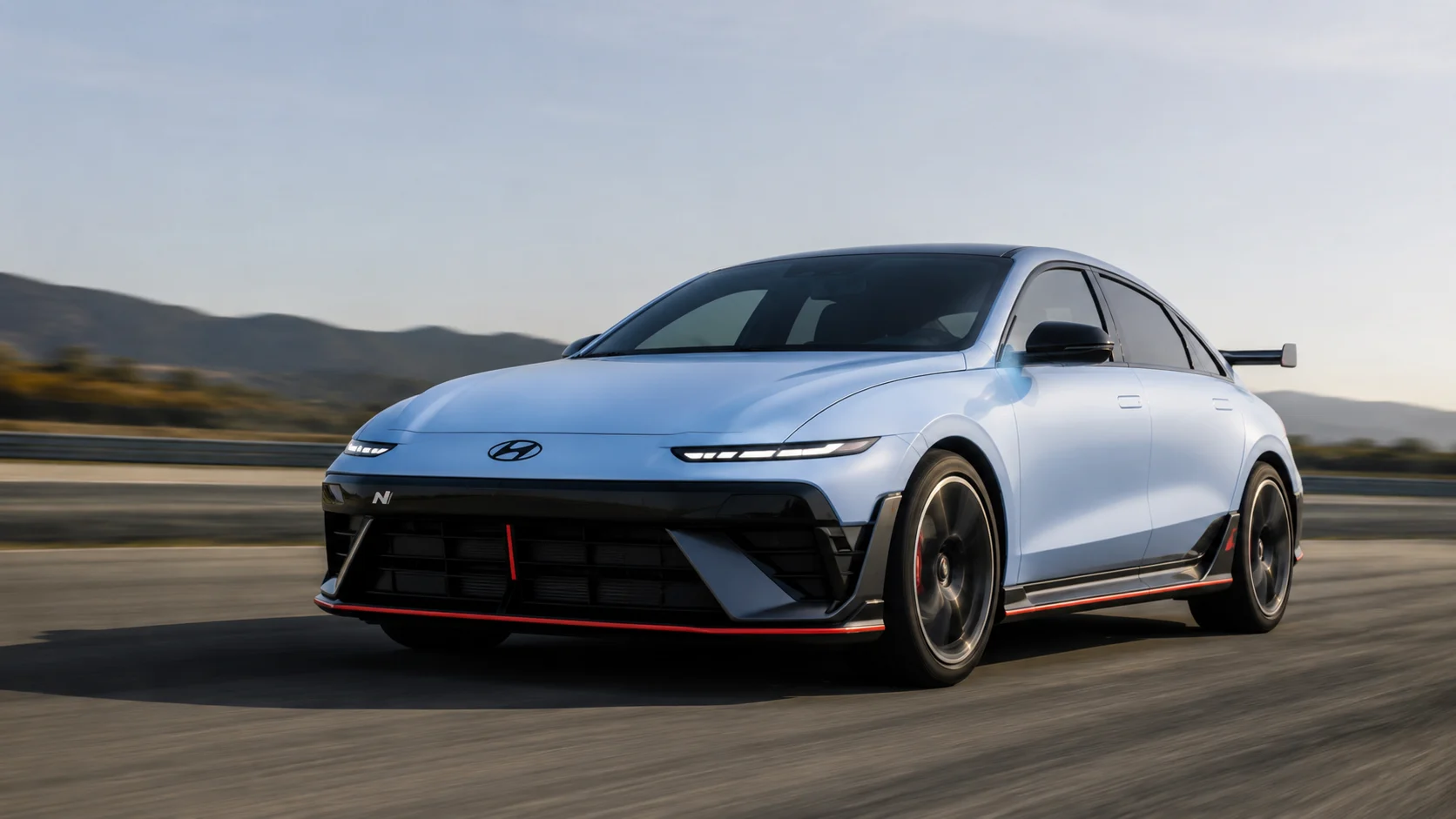
The 2026 Hyundai IONIQ 6 N takes Hyundai’s sleek electric sedan and turns it into a serious high-performance EV. Unveiled at the 2025 Goodwood Festival of Speed, the IONIQ 6 N combines a dual-motor all-wheel-drive powertrain with 650 PS, 770 Nm of torque, track-focused suspension, larger brakes, aggressive aerodynamics and an 84-kWh battery.
It is not simply a faster version of the regular IONIQ 6. Hyundai has redesigned important parts of the car around performance, including its suspension geometry, battery thermal management, steering, braking and aerodynamic package. The result is an electric sports sedan designed to work on both public roads and a racetrack.
Quick Answer
The 2026 Hyundai IONIQ 6 N is Hyundai N’s second high-performance electric vehicle after the IONIQ 5 N. It uses two permanent-magnet electric motors and an 84-kWh lithium-ion battery.
With N Grin Boost activated, the system produces up to 650 PS (478 kW) and 770 Nm. Hyundai quotes 0-100 km/h in 3.2 seconds with N Launch Control and a 257 km/h (160 mph) top speed.
European-market specifications currently list a WLTP range of up to 487 km (302 miles). Hyundai also states that the battery can charge from 10% to 80% in approximately 18 minutes when connected to a suitable 350-kW DC fast charger under optimal conditions.
The UK market has confirmed pricing, with an on-the-road price of £65,800 for the 84-kWh, 650-PS AWD model based on Hyundai UK’s April 2026 pricing document.
What Is the 2026 Hyundai IONIQ 6 N?
The IONIQ 6 N is the performance-focused version of Hyundai’s electric streamliner sedan. It sits within Hyundai’s N performance family and follows the IONIQ 5 N as the company’s second high-performance EV.
Hyundai officially unveiled the IONIQ 6 N on July 10, 2025, at the Goodwood Festival of Speed in the United Kingdom. The car was developed around Hyundai N’s three-part philosophy of being a “Corner Rascal,” offering racetrack capability and still functioning as an everyday sports car.
That philosophy explains why the IONIQ 6 N goes beyond adding more electric power. Hyundai has worked on the chassis, suspension, braking, aerodynamics and battery management so the car can handle repeated high-performance driving.
In April 2026, the IONIQ 6 N was named 2026 World Performance Car at the World Car Awards, giving Hyundai’s N division its second win in the category after the IONIQ 5 N in 2024.
2026 Hyundai IONIQ 6 N Specifications
| Specification | 2026 Hyundai IONIQ 6 N |
|---|---|
| Powertrain | Dual electric motors |
| Drive type | All-wheel drive |
| Battery | 84.0 kWh lithium-ion |
| Standard combined output | 448 kW / 609 PS |
| N Grin Boost output | 478 kW / 650 PS |
| Standard torque | 740 Nm |
| N Grin Boost torque | 770 Nm |
| 0-100 km/h | 3.2 seconds with N Launch Control |
| Top speed | 257 km/h / 160 mph |
| WLTP range | Up to 487 km / 302 miles |
| DC fast charging | 10-80% in about 18 minutes with 350 kW |
| Length | 4,935 mm |
| Width | 1,940 mm |
| Height | 1,495 mm |
| Wheelbase | 2,965 mm |
| Tires | 275/35R20 |
| Drag coefficient | 0.27 |
Specifications can vary slightly by market and measurement standard. Hyundai’s European technical information confirms the 84-kWh battery, 448-kW normal combined output, 478-kW N Grin Boost output and 740/770-Nm torque figures.
Performance: 650 PS and 770 Nm
The IONIQ 6 N uses a dual-motor electric powertrain with one motor at each axle. The front motor is rated at up to 175 kW and the rear motor at up to 303 kW when N Grin Boost is active. Combined peak output reaches 478 kW, equivalent to 650 PS.
Without the temporary boost function, Hyundai lists combined output at 448 kW and 609 PS, with maximum torque of 740 Nm. N Grin Boost raises those figures to 478 kW, 650 PS and 770 Nm.
The headline acceleration figure is 0-100 km/h in 3.2 seconds using N Launch Control. Hyundai’s European technical data also lists 3.4 seconds without boost, 3.3 seconds with N Grin Boost and 3.2 seconds when N Launch Control is used.
Top speed is electronically limited to 257 km/h, or approximately 160 mph.
N Grin Boost and N Launch Control
N Grin Boost is Hyundai N’s temporary performance boost function. In the IONIQ 6 N, it increases the available power and torque for maximum acceleration.
N Launch Control is designed to provide the quickest possible standing start by managing the electric powertrain and traction system for acceleration.
These features make the IONIQ 6 N’s performance numbers particularly impressive, but they also show why the car has been engineered differently from a conventional IONIQ 6. Its performance package is designed around controlling repeated bursts of high power rather than simply producing a large peak number.
Battery and Range
The IONIQ 6 N uses an 84.0-kWh high-voltage battery. Hyundai developed its N Battery management system specifically to manage the thermal demands associated with performance driving.
Battery temperature matters considerably in a high-performance EV. Hard acceleration, repeated high-speed driving and track use can generate substantial heat, so Hyundai uses dedicated cooling and heating strategies to keep the battery within an appropriate operating range.
For European models, Hyundai currently quotes up to 487 km (302 miles) of WLTP range. The UK technical specification lists energy consumption of 21.2 kWh/100 km and a 302-mile WLTP range.
That figure should not be interpreted as a guaranteed real-world range. Weather, speed, temperature, driving style, tire choice and road conditions can all affect actual EV range. Hyundai itself notes that the stated range can vary depending on these conditions.
800-Volt Charging and 18-Minute Fast Charging
One of the IONIQ 6 N’s strongest practical features is its fast-charging capability.
Hyundai says the 84-kWh battery can charge from 10% to 80% in approximately 18 minutes when using a 350-kW charger under optimal conditions.
The UK technical data also lists approximately 7 hours and 35 minutes for a 10-100% charge using an 11-kW AC connection, while a 50-kW DC charger takes about 1 hour and 19 minutes for 10-80%.
The 18-minute figure is therefore a maximum-condition fast-charging claim rather than a guarantee that every charging session will take exactly 18 minutes. Charger output, battery temperature, battery state of charge and other conditions influence charging speed.
Track-Focused Battery Management
The IONIQ 6 N’s battery system is designed with more than everyday commuting in mind.
Hyundai’s N Battery system includes thermal management designed for different performance situations. The company describes dedicated strategies for scenarios such as sprint, drag and endurance driving, allowing battery temperature to be managed according to the type of performance demanded.
The system also incorporates battery conditioning. Hyundai says improvements to the battery heater reduce conditioning time, helping the vehicle prepare the battery for performance or charging more efficiently.
This is an important distinction between the IONIQ 6 N and an ordinary high-output EV. Peak power is only useful if the battery and motors can maintain appropriate operating temperatures.
Suspension and Handling
Hyundai has given the IONIQ 6 N a substantially revised chassis.
The suspension geometry has been redesigned with a lower roll center, while electronically controlled suspension allows damping characteristics to be adjusted for different driving conditions. Hyundai says the revised setup is intended to provide predictable handling during high-performance driving without sacrificing everyday usability.
The car also uses specially developed bushings and reinforced body structures to improve body control.
For a performance EV, these changes matter because the battery adds considerable mass. Controlling that weight through corners requires more than simply increasing motor output.
Brakes, Tires and Electronic Limited-Slip Differential
The IONIQ 6 N uses larger performance brakes, with 400-mm front discs and four-piston front calipers, along with 360-mm rear discs. Hyundai also lists regenerative deceleration of up to 0.6 G under appropriate conditions.
The car rides on 20-inch forged wheels and 275/35R20 performance tires. Hyundai specifies specially developed Pirelli P Zero tires for the IONIQ 6 N.
An electronic limited-slip differential is also part of the performance hardware. Its purpose is to help manage torque between the driven wheels and improve traction and corner-exit behavior.
Aerodynamics and Exterior Design
The IONIQ 6 N looks considerably more aggressive than the standard electric sedan.
Its body has widened fenders, a lower and more performance-oriented stance, larger wheels and a prominent rear wing. Hyundai says the aerodynamic package was developed to balance downforce and drag reduction, with the goal of improving high-speed stability.
The rear swan-neck wing is one of the most obvious visual changes. It gives the sedan a much stronger motorsport-inspired appearance while serving an aerodynamic purpose.
Despite those changes, Hyundai retains the IONIQ 6’s basic streamlined concept. The published drag coefficient is 0.27, showing that aerodynamic efficiency remains part of the vehicle’s design despite its track-oriented bodywork.
N e-Shift Makes the EV Feel Different
Electric motors do not need traditional multi-speed transmissions to deliver strong acceleration. Hyundai nevertheless developed N e-Shift to give the IONIQ 6 N a more conventional performance-car sensation.
The system simulates gear changes and provides feedback during acceleration and deceleration. Hyundai says it is designed to replicate the feeling of close gear ratios inspired by motorsport and to increase driver engagement.
It does not mean the IONIQ 6 N has a conventional gasoline-engine transmission. Instead, N e-Shift is a software-based interface intended to make power delivery feel more interactive.
N Active Sound+
Hyundai also uses N Active Sound+ to give the IONIQ 6 N a more dramatic auditory character.
The system works alongside N e-Shift to provide additional feedback about acceleration and simulated gear changes. It is part of Hyundai N’s attempt to address something that naturally disappears when a performance car moves from an internal-combustion engine to electric propulsion: mechanical sound and sensation.
Drivers who prefer a quieter EV can approach the system differently, but its presence shows that Hyundai considers driver involvement to be an important part of the N experience.
Drift and Track Features
The IONIQ 6 N includes a collection of software and chassis controls aimed at performance driving.
Hyundai has developed an N Drift Optimizer that allows drivers to adjust the vehicle’s behavior for controlled oversteer. The system works with the electric motors, chassis controls and other performance systems rather than relying on a conventional mechanical powertrain.
N Track Manager also provides a way to configure and monitor performance-related settings for track driving. Hyundai positions these functions as part of the car’s broader focus on driver involvement and racetrack use.
These systems are intended for controlled environments and should not be treated as features to experiment with on public roads.
Interior and Technology
The cabin follows the broader IONIQ design language but receives a more performance-focused treatment.
Hyundai’s UK specifications list N bucket seats, an N steering wheel, Alcantara suede upholstery and performance-oriented trim details. The car also includes Hyundai Digital Key 2, vehicle-to-load capability and over-the-air software updates.
The combination is intended to make the IONIQ 6 N usable as a daily car rather than a track-only machine.
Its practical technology also extends beyond performance. Hyundai highlights connected features, driver assistance systems and convenience technology alongside the N-specific hardware.
Safety and Driver Assistance
The IONIQ 6 N is positioned as a road-going vehicle, so performance technology is accompanied by modern safety and driver-assistance equipment.
Hyundai describes the model as incorporating advanced driver-assistance and convenience technology, although exact equipment can vary by market. Buyers should therefore check the local specification rather than assuming that every feature shown on Hyundai’s global or European websites is included in every country.
This market-specific approach is especially important for safety systems, because equipment, regulations and naming conventions can differ between countries.
2026 Hyundai IONIQ 6 N Price and Availability
Pricing is market-specific, and Hyundai has not established one universal global price.
In the United Kingdom, Hyundai’s pricing information effective April 1, 2026 lists the IONIQ 6 N 84-kWh 650-PS 4WD at £65,010 retail price, with a £65,800 recommended on-the-road price.
Hyundai UK’s current offer page also lists the £65,800 on-the-road price for the 84-kWh AWD model.
The availability and specification situation is different in other markets. Hyundai’s global material explicitly notes that vehicle specifications, options and availability can vary by country.
For that reason, a UK price should not be converted directly into a U.S., Indian or other-market price and presented as an official figure.
Is the IONIQ 6 N Coming to the U.S.?
Hyundai has publicly presented the IONIQ 6 N in North America, including a North American premiere at AutoMobility LA. Hyundai’s North American material confirms the same 84-kWh battery and 478-kW/641-hp boost output for that market presentation.
However, U.S. specifications, pricing and availability should be checked against Hyundai’s U.S. market announcements rather than assumed from European data.
This is particularly important because the European vehicle uses PS figures, while Hyundai’s North American documentation quotes horsepower. The 650-PS global figure is presented as 641 hp in Hyundai’s U.S. material.
How Does the IONIQ 6 N Compare With the IONIQ 5 N?
The IONIQ 6 N and IONIQ 5 N share Hyundai N’s high-performance EV philosophy and several technologies, but their body styles and aerodynamic priorities are different.
The IONIQ 5 N is a performance-oriented crossover, while the IONIQ 6 N is a low-slung electric sports sedan. The IONIQ 6 N’s streamlined body and lower stance give Hyundai a different platform for balancing high-speed stability, efficiency and handling.
Both cars use N-specific performance systems such as N Grin Boost, N e-Shift and N Active Sound+, but the IONIQ 6 N receives its own suspension geometry, aerodynamic package and chassis tuning.
The IONIQ 6 N therefore should not be viewed simply as an IONIQ 5 N with a different body. Hyundai has engineered the sedan around its own performance characteristics.
What Makes the IONIQ 6 N Different?
The most interesting part of the IONIQ 6 N is not the 650-PS headline number by itself.
Hyundai is trying to solve a broader problem for performance EVs: how to make a very fast electric car engaging to drive repeatedly.
That explains the combination of adjustable suspension, electronic differential control, advanced battery cooling, performance braking, N e-Shift, simulated sound, drift settings and track-management software.
The car is also unusual because it combines those performance ambitions with a relatively aerodynamic sedan body and a claimed WLTP range of up to 487 km in Europe.
Pros and Limitations
Pros
- Up to 650 PS and 770 Nm with N Grin Boost
- 0-100 km/h in 3.2 seconds with N Launch Control
- 257 km/h top speed
- 84-kWh battery
- Up to 487 km WLTP range in Europe
- 350-kW charging capability with an approximately 18-minute 10-80% claim under optimal conditions
- Track-focused suspension and braking hardware
- Electronic limited-slip differential
- N e-Shift and N Active Sound+
- Extensive performance-focused software
- Usable everyday four-door format
Limitations
- Performance hardware and tires can prioritize driving dynamics over efficiency
- WLTP range is not a guarantee of real-world range
- The quickest charging times depend on suitable high-power charging equipment and battery conditions
- Specifications, equipment and availability vary between markets
- The car’s performance-oriented character may be more than some everyday EV buyers need
- Official pricing is not globally uniform
Who Is the 2026 Hyundai IONIQ 6 N For?
The IONIQ 6 N makes the most sense for drivers who want an EV that can deliver serious acceleration without abandoning the involvement associated with a performance car.
It is particularly interesting for enthusiasts who want track-focused chassis technology, adjustable driving behavior and stronger sensory feedback than a conventional EV provides.
For buyers who primarily want maximum range, low running costs and relaxed commuting, a less powerful IONIQ model may make more sense. The IONIQ 6 N is deliberately built around performance, and its engineering reflects that priority.
Final Thoughts
The 2026 Hyundai IONIQ 6 N is one of the clearest examples of Hyundai N adapting its performance philosophy to electric power.
Its 650-PS peak output, 770 Nm of torque and 3.2-second 0-100 km/h time make it genuinely quick, but the more important story is underneath those numbers. Hyundai has developed dedicated suspension geometry, battery thermal management, braking hardware, aerodynamic components and software to make the IONIQ 6 N more than a straight-line EV.
The car also retains useful everyday characteristics, including four-door practicality, fast charging and a European WLTP range of up to 487 km.
The biggest caveat is market variation. Pricing, equipment and availability are not identical worldwide, so buyers should use their local Hyundai market information before making a purchasing decision. Official range figures can also differ substantially from real-world results depending on conditions.
For enthusiasts looking at high-performance EVs in 2026, however, the IONIQ 6 N represents a distinctive approach: instead of trying to hide the differences between electric and combustion performance cars, Hyundai has used software, sound, chassis tuning and battery management to create a different kind of sports sedan.
Frequently Asked Questions
How much power does the 2026 Hyundai IONIQ 6 N have?
The IONIQ 6 N produces up to 650 PS (478 kW) and 770 Nm with N Grin Boost. Hyundai lists 609 PS and 740 Nm as the standard combined output.
How fast is the Hyundai IONIQ 6 N from 0 to 100 km/h?
Hyundai quotes 3.2 seconds from 0 to 100 km/h when N Launch Control is used.
What is the top speed of the IONIQ 6 N?
The 2026 IONIQ 6 N has a top speed of 257 km/h, equivalent to about 160 mph.
What battery does the IONIQ 6 N use?
The car uses an 84.0-kWh lithium-ion battery.
What is the range of the IONIQ 6 N?
Hyundai currently lists up to 487 km (302 miles) WLTP for European-market versions. Actual range can vary according to speed, temperature, road conditions, driving style and tires.
How long does the IONIQ 6 N take to charge?
Using a suitable 350-kW DC fast charger, Hyundai quotes approximately 18 minutes for a 10-80% charge under optimal conditions.
How much does the 2026 Hyundai IONIQ 6 N cost?
Pricing depends on the market. In the UK, Hyundai’s April 2026 pricing lists the 84-kWh 650-PS AWD model at £65,800 recommended on-the-road price.
Is the IONIQ 6 N a real performance car or just a fast EV?
It is designed as a high-performance EV rather than simply a high-output version of the standard IONIQ 6. Hyundai has developed dedicated suspension geometry, performance brakes, an electronic limited-slip differential, track-oriented battery management, aerodynamic components and N-specific driving software.
Has the IONIQ 6 N won any major awards?
Yes. The IONIQ 6 N was named 2026 World Performance Car at the World Car Awards announced on April 2, 2026.
Sources & References
- Hyundai Worldwide — IONIQ 6 N official announcement and specifications
- Hyundai Motor Europe — IONIQ 6 N official technical data
- Hyundai UK — IONIQ 6 N technical data and range information
- Hyundai UK — IONIQ 6 N pricing and equipment information
- Hyundai Worldwide — IONIQ 6 N Goodwood world premiere
- Hyundai — IONIQ 6 N World Performance Car announcement
- Car and Driver — 2026 Hyundai IONIQ 6 N review and driving impressions