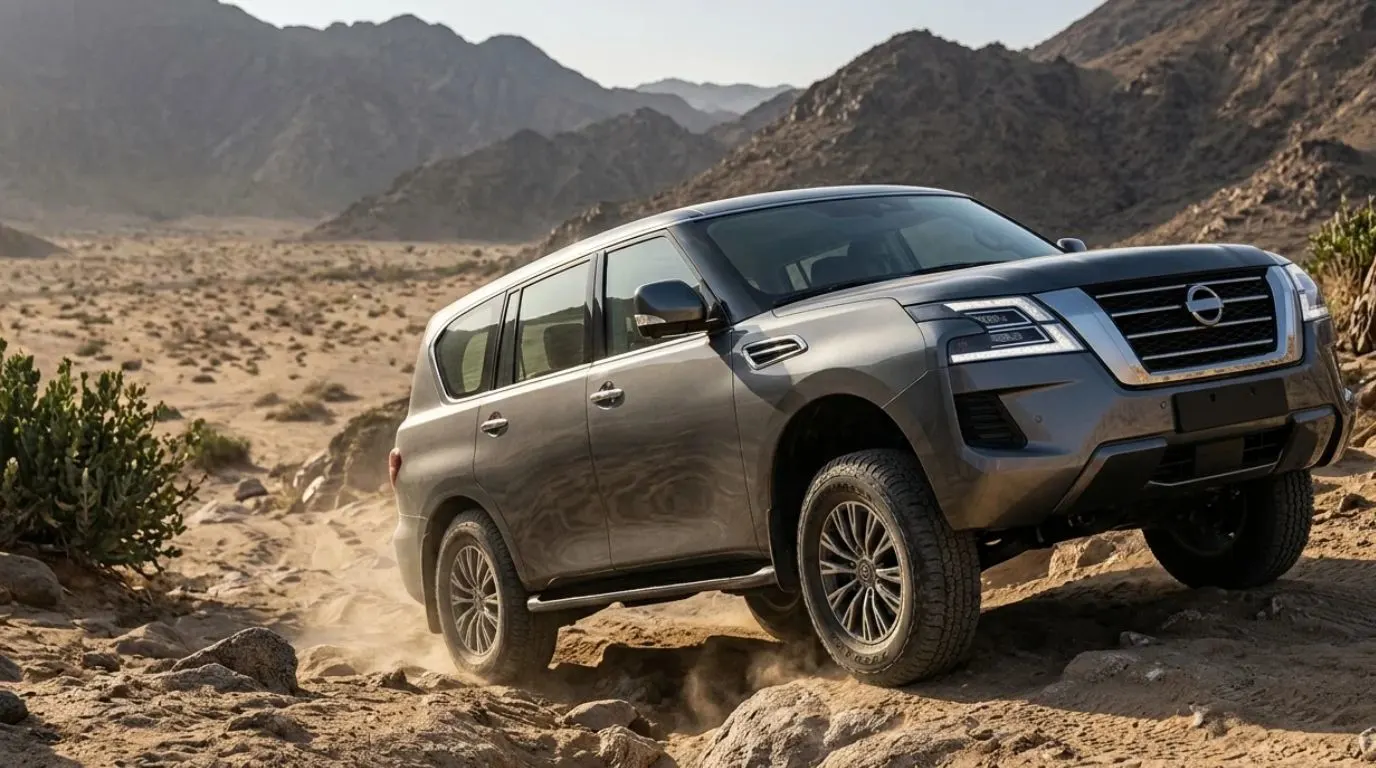
The Nissan Patrol is a full-size SUV developed for drivers who need strong engine performance, four-wheel-drive capability and the ability to travel across challenging terrain. Its combination of a powerful petrol engine, low-range gearing, advanced traction systems and rugged chassis construction has made it a well-known choice for off-road enthusiasts and long-distance touring.
The latest seventh-generation Patrol, known as the Y63, introduces a major change to the model’s powertrain. Nissan has replaced the previous generation’s naturally aspirated V8 engine with V6 options, including a 3.5-litre twin-turbocharged unit. However, the Patrol’s off-road character remains central to its design.
Engine specifications, ground clearance, suspension equipment and available off-road features vary by generation and market. This is particularly important when comparing the new Y63 with the Y62 Patrol, which continues to be offered in some markets.
For buyers considering the Patrol, the important questions are how much power its engines produce, how its 4WD system works, what ground clearance it offers and which features help it handle sand, rocks, mud and uneven trails.
Nissan Patrol Engine Options and Performance
The seventh-generation Nissan Patrol is available with two V6 petrol engine options in selected markets. The choice between them matters because their power and torque outputs are considerably different.
3.5-litre twin-turbo V6 engine
The 3.5-litre twin-turbocharged V6 is the more powerful engine in the new Patrol range. Nissan introduced it as the replacement for the previous generation’s 5.6-litre V8.
Its main specifications are:
- Engine: 3.5-litre twin-turbocharged V6
- Maximum power: 425 hp (317 kW)
- Maximum torque: 700 Nm
- Transmission: 9-speed automatic
- Drivetrain: Four-wheel drive
The engine produces substantial torque, which is particularly useful when accelerating a large SUV, climbing steep gradients or towing heavy loads.
One interesting engineering detail is its scavenge oil pump. Nissan designed this system to help maintain engine lubrication when the vehicle is travelling on steep inclines or uneven terrain. Consistent oil circulation is important because prolonged steep-angle driving can affect how engine oil collects inside the sump.
Nissan also uses a high heat-resistant turbocharger as part of the engine’s design.
The result is a powertrain that combines strong acceleration with the torque needed for demanding driving conditions. It is also paired with a nine-speed automatic transmission, giving the engine a wider range of gearing for different speeds and loads.
3.8-litre naturally aspirated V6 engine
The second option is a 3.8-litre naturally aspirated V6 petrol engine.
Unlike the twin-turbo version, this engine does not use turbochargers to increase intake pressure. Its power delivery comes from its naturally aspirated configuration.
| Specification | 3.8L V6 |
|---|---|
| Engine type | Naturally aspirated V6 |
| Displacement | 3.8 litres |
| Maximum power | 316 hp |
| Maximum torque | 386 Nm |
| Transmission | 9-speed automatic |
This engine is available in selected Middle Eastern markets and provides a lower-output alternative to the twin-turbo V6.
The difference is particularly noticeable in torque. The twin-turbo engine produces 700 Nm, compared with 386 Nm from the naturally aspirated unit.
For drivers who regularly travel through sand, climb steep tracks or carry heavy loads, the additional torque of the 3.5-litre engine offers a meaningful performance advantage.
How does the Nissan Patrol perform on the road?
The Patrol’s large body and substantial weight mean that engine performance is important beyond outright acceleration.
The twin-turbo V6 provides the power needed for highway overtaking, carrying passengers and maintaining momentum on inclines. The nine-speed automatic transmission also helps manage engine speed across different driving conditions.
Its 700 Nm torque output is especially relevant when the SUV is fully occupied or carrying equipment for a long-distance journey.
However, engine power alone does not determine off-road capability. Low-range gearing, traction control, differential locking, suspension movement and tyre selection all influence how effectively the Patrol handles difficult terrain.
Nissan Patrol 4WD System Explained
The Nissan Patrol’s four-wheel-drive system is one of its most important features for off-road driving.
Unlike a conventional two-wheel-drive SUV, the Patrol is designed to distribute driving force through all four wheels, helping maintain traction when the surface becomes loose, uneven or slippery.
The seventh-generation Y63 uses a full-time 4WD system with an interlocking transfer case. In the Australian specification announced in August 2026, Nissan confirms both 4H and 4L operating modes, along with an electronically controlled rear differential lock.
What are 4H and 4L?
The transfer case allows the driver to select different gearing for the driving conditions.

4H (High-range four-wheel drive)
4H is intended for normal driving and situations where additional traction is required without the very low gearing of the low-range setting.
It is useful for:
- Loose gravel roads
- Sandy tracks
- Wet or slippery surfaces
- Uneven country roads
- General off-road touring
High-range gearing allows the vehicle to maintain more normal driving speeds while distributing power through the four-wheel-drive system.

4L (Low-range four-wheel drive)
4L provides a lower overall gear ratio, increasing the torque multiplication available at the wheels.
It is particularly useful for:
- Steep climbs
- Rocky trails
- Controlled descents
- Deep or difficult terrain
- Slow-speed manoeuvres over obstacles
Low-range gearing allows the driver to move more slowly while maintaining better control over the vehicle’s movement.

It also reduces the need to rely excessively on the accelerator when navigating difficult obstacles.
Electronic locking rear differential
Another important feature is the electronically controlled rear differential lock.
A conventional open differential allows the two wheels on an axle to rotate at different speeds. This is useful when turning on normal roads, but it can become a disadvantage when one wheel loses traction.
For example, imagine the Patrol travelling across a rocky trail. If one rear wheel is on a slippery surface and begins spinning, an open differential may struggle to deliver useful driving force to the wheel with better grip.
A locking rear differential helps address this problem by mechanically coupling the two rear wheels so they rotate together.
This can improve traction when one rear wheel has limited grip.
However, a rear differential lock is not a substitute for careful driving. It is generally intended for low-traction conditions and should be disengaged when normal road handling is required, following the owner’s manual.
Nissan Patrol drive modes
The new-generation Patrol also offers selectable driving modes designed for different surfaces and driving requirements.
Nissan’s global launch information identifies six modes:
| Drive Mode | Main Purpose |
|---|---|
| Standard | Everyday driving conditions |
| Sand | Loose sand surfaces |
| Rock | Rocky and uneven terrain |
| Mud/Rut | Muddy tracks and rutted surfaces |
| Eco | Efficiency-focused driving |
| Sport | More responsive road performance |
These modes adjust aspects of vehicle behaviour, such as throttle response and transmission operation, to suit the selected driving environment.
For example, Sand mode is intended to help the driver maintain momentum on loose surfaces, while Rock mode is designed for slower, more controlled progress over uneven terrain.
The availability and operation of individual modes can vary with the market and vehicle specification.

Nissan Patrol Ground Clearance and Off-Road Dimensions
Ground clearance is an important consideration when choosing a large off-road SUV.
It refers to the minimum distance between the ground and the lowest relevant part of the vehicle’s underside. More clearance can reduce the likelihood of the underbody contacting rocks, raised tracks and other obstacles.
However, ground clearance is only one part of off-road geometry. Approach angle, departure angle, breakover angle, wheelbase and suspension articulation also influence a vehicle’s ability to negotiate difficult terrain.
What is the Nissan Patrol’s ground clearance?
There is no single ground-clearance figure that should be applied to every seventh-generation Nissan Patrol.

Nissan’s Middle Eastern model information lists 244 mm for a specified Patrol version. This figure should not automatically be treated as the measurement for every engine, trim or suspension configuration.
The Australian Y63 specifications announced in 2026 also introduce adaptive air suspension on selected grades, allowing the vehicle’s ride height to be raised for off-road driving. Nissan’s published Australian announcement does not provide one universal minimum ground-clearance figure for the entire Y63 range.
For comparison, the previous-generation Y62 Patrol sold in Australia has an officially listed minimum ground clearance of 273 mm.
These figures belong to different generations and market specifications, so they should not be used as a direct comparison of the new Patrol’s standard ride height.

Adaptive air suspension and adjustable ride height
Selected Y63 Patrol grades offer adaptive air suspension combined with Intelligent Dynamic Damping.
This system allows the vehicle to adjust its ride height depending on the driving situation.
Its main benefits include:
- Raising the body for improved off-road clearance.
- Helping improve approach, breakover and departure angles.
- Lowering the vehicle for easier passenger entry and exit.
- Making it more convenient to load and unload luggage.
- Adjusting suspension behaviour for improved ride comfort.
The system is particularly relevant to the PRO-4X and Ti-L Reserve grades in the Australian range announced by Nissan.
The important distinction is that adaptive air suspension is not standard across every Patrol grade. Buyers should check the exact equipment fitted to their chosen version.
Approach, departure and breakover angles
Ground clearance alone cannot explain how easily an SUV can cross an obstacle.
Three additional measurements are particularly useful.
Approach angle: This measures how steep an obstacle can be before the front bumper or another front-end component makes contact with the ground.
Departure angle: This measures the angle the vehicle can leave an obstacle without the rear bumper or underbody making contact.
Breakover angle: This indicates how steep a crest the vehicle can cross without its underside touching the highest point of the obstacle.
A long-wheelbase SUV can have good ground clearance but still struggle with certain sharp crests because of its overall dimensions.
The Patrol’s adjustable ride height on equipped grades is intended to help improve these angles when travelling off-road.
Nissan Patrol Off-Road Features
Beyond its engine and four-wheel-drive hardware, the Patrol includes several features designed to make off-road driving more manageable.
These systems are particularly useful when travelling through unfamiliar terrain, where visibility, traction and suspension control can make a significant difference.
1. Adaptive suspension and Intelligent Dynamic Damping
The seventh-generation Patrol offers Intelligent Dynamic Damping on selected grades.
This technology adjusts suspension damping according to driving conditions, helping manage body movement and maintain ride comfort.
The system is particularly useful in a large SUV because its weight and dimensions can make body movements more noticeable over uneven surfaces.
Higher Australian grades, including the PRO-4X and Ti-L Reserve, combine Intelligent Dynamic Damping with adaptive air suspension.
2. Invisible Hood View
One of the more interesting technology features in the new Patrol is Nissan’s Invisible Hood View.
Off-road drivers sometimes struggle to see the ground immediately in front of a large SUV. The bonnet and front bodywork can hide obstacles, particularly when approaching steep crests or navigating narrow trails.
Invisible Hood View uses camera technology to display an image of the area underneath and ahead of the front of the vehicle.
This helps drivers judge the position of obstacles that might otherwise be difficult to see from the driving seat.
It can be especially useful when:
- Crossing rocky sections.
- Approaching steep sand dunes.
- Driving along narrow trails.
- Manoeuvring around large obstacles.
- Positioning the front wheels on uneven ground.
It does not replace direct observation or careful driving, but it can improve the driver’s awareness of the terrain.
3. 3D Around View Monitor
The Patrol also offers a 3D Around View Monitor on selected versions.
It combines camera views to help drivers understand the vehicle’s surroundings.
This is useful because the Patrol is a large SUV, and judging its position can be difficult when navigating tight spaces or obstacles.
The camera system can assist with:


- Parking in confined areas.
- Avoiding rocks and obstacles.
- Manoeuvring on narrow trails.
- Checking the space around the vehicle.
For off-road use, the additional visibility can be particularly valuable when the driver cannot easily see the front corners or sides of the vehicle.
4. PRO-4X off-road specification
The PRO-4X is the more off-road-focused version of the new Patrol range.
In Nissan Australia’s 2026 specification announcement, it includes several additions over the regular Ti-L equipment.
These include:
- Adaptive air suspension.
- Intelligent Dynamic Damping.
- All-terrain tyres.
- 20-inch black-painted alloy wheels.
- PRO-4X-specific off-road front bumper fascia.
The combination is intended to make the Patrol better suited to drivers who regularly travel beyond paved roads.
All-terrain tyres are particularly relevant because they are designed to provide a more versatile balance of grip on paved roads and loose surfaces than conventional road-focused tyres.
The PRO-4X also benefits from adjustable ride height, which can help when travelling across uneven terrain.
However, buyers should remember that larger wheels and tyre choices can affect ride comfort, sidewall protection and replacement costs. The most suitable configuration depends on how frequently the vehicle will be used off-road.
Nissan Patrol Suspension and Chassis
A capable off-road SUV needs more than a powerful engine and four-wheel drive. Its chassis and suspension must also handle uneven surfaces without compromising stability and passenger comfort.
The Y63 Patrol introduces an updated ladder-frame chassis.
According to Nissan Australia, the new frame offers 40% more torsional rigidity than the previous generation.
Torsional rigidity describes how resistant a vehicle’s structure is to twisting forces. This is important when the SUV travels across uneven terrain, where different wheels can encounter different heights and loads.
The new Patrol also uses multi-link independent suspension.
This suspension arrangement is designed to balance handling, comfort and wheel control.
Its benefits include:
- Better management of uneven road surfaces.
- Improved suspension response.
- Greater passenger comfort during long journeys.
- More controlled vehicle behaviour.
- Support for both highway driving and off-road touring.
The combination of a stronger ladder frame and updated suspension gives the new Patrol a foundation for its dual role as a family SUV and an off-road vehicle.

How Capable Is the Nissan Patrol on Sand, Rocks and Mud?
The Patrol’s off-road hardware is designed to address several different driving environments. However, the appropriate combination of drive mode, gearing and driving technique depends on the terrain.
Driving on sand
Sand driving requires maintaining momentum without allowing the tyres to dig too deeply into loose surfaces.
The Patrol’s Sand mode is designed for this type of environment.
Its four-wheel-drive system helps distribute power to all four wheels, while the available low-range gearing provides additional control when conditions become difficult.
Tyre pressure is also important when driving on sand. The correct pressure depends on the terrain, tyre specification, vehicle load and manufacturer’s recommendations.
Drivers should avoid sudden acceleration and excessive steering inputs, particularly when climbing dunes.
Driving on rocky trails
Rocky terrain places greater demands on suspension control, traction and underbody protection.
The Rock mode is designed for these conditions, while 4L provides the low-speed gearing required for controlled movement.
The electronic rear differential lock can also help when one rear wheel loses traction.
The Invisible Hood View is another useful feature because it can help drivers identify obstacles directly ahead of the vehicle.
However, wheel placement remains important. A large SUV can still damage its tyres, wheels or underbody if it attempts to cross an obstacle that exceeds its physical capabilities.
Driving through mud
Mud can quickly reduce tyre grip, making it difficult for a heavy SUV to maintain forward movement.

The Patrol’s Mud/Rut mode is intended to adapt vehicle behaviour to these conditions.
Its four-wheel-drive system, selectable drive modes and rear differential lock can help maintain traction when one or more wheels encounter slippery surfaces.
Nevertheless, deep mud can present serious challenges. Mud depth, tyre tread, ground clearance and the consistency of the surface all influence how successfully the vehicle can pass through it.
Climbing steep inclines
The Patrol’s 700 Nm twin-turbo V6 engine provides substantial torque for climbing.
Its scavenge oil pump is also designed to maintain engine lubrication when the vehicle is operating at steep angles.
For difficult climbs, low-range gearing can help the driver maintain a controlled speed without relying heavily on accelerator input.
The driver should also consider the vehicle’s approach angle, available traction and the condition of the surface before attempting a steep climb.
Nissan Patrol: Important Specifications at a Glance
The following table summarises the key specifications of the seventh-generation Patrol. Equipment and specifications can differ by market and trim.
| Specification | Nissan Patrol Y63 |
|---|---|
| Engine options | 3.5L twin-turbo V6 / 3.8L naturally aspirated V6 |
| Maximum power | 425 hp / 316 hp |
| Maximum torque | 700 Nm / 386 Nm |
| Transmission | 9-speed automatic |
| Drivetrain | Full-time 4WD |
| Transfer case | 4H and 4L |
| Rear differential | Electronic locking rear differential |
| Drive modes | Six modes in Nissan’s global launch specification |
| Suspension | Multi-link independent |
| Adaptive air suspension | Available on selected grades |
| Ground clearance | 244 mm listed for a specified Middle Eastern version |
| Off-road camera technology | Invisible Hood View and 3D Around View Monitor on selected versions |
Nissan Patrol Y63 vs Y62: What Has Changed for Off-Road Driving?
The Y63 represents an important change in the Patrol’s engineering.
The previous Y62 generation became known for its 5.6-litre naturally aspirated V8 petrol engine, while the new generation moves to V6 power.
Here are some of the major differences.
| Feature | Y62 Patrol | Y63 Patrol |
|---|---|---|
| Main engine | 5.6L naturally aspirated V8 in Australia | 3.5L twin-turbo V6 |
| Maximum power | 298 kW in Australian specification | 317 kW in Australian specification |
| Maximum torque | 560 Nm | 700 Nm |
| Transmission | 7-speed automatic | 9-speed automatic |
| Chassis | Ladder frame | Updated ladder frame |
| Suspension | Independent double wishbone | Multi-link independent |
| Air suspension | Not listed for the Australian Y62 range | Available on selected grades |
| Off-road technology | Intelligent 4×4 and electronic rear differential lock | Updated 4WD system, selectable terrain modes and additional camera technology |
The figures above refer to the Australian specifications and should not be treated as a universal comparison across every international version.
The biggest mechanical change is the move from the V8 to the twin-turbo V6. Despite having fewer cylinders and a smaller displacement, the new engine produces more power and considerably more torque in the Australian specification.
The Y63 also adds updated suspension technology and more advanced driver-visibility features.
For buyers, the difference is not simply about engine performance. The newer generation places greater emphasis on combining off-road equipment with modern comfort and technology.
Nissan Patrol Availability: What Buyers Should Know
The seventh-generation Patrol made its global debut in Abu Dhabi on September 4, 2024.
Nissan announced its Middle Eastern availability from November 1, 2024, with regional specifications and equipment varying between markets.
Australia has a separate transition timeline.
On August 27, 2026, Nissan Australia announced pricing and specifications for the new Y63 range. Orders opened following the announcement, with first customer deliveries expected in early 2027.
The Australian range includes six grades:
- Ti
- Ti+
- Ti-L
- Ti-L+
- PRO-4X
- Ti-L Reserve
The PRO-4X is particularly relevant to buyers interested in off-road driving because it combines all-terrain tyres, adaptive air suspension and a dedicated off-road appearance.
The previous Y62 generation remains relevant in markets where the new model has not yet replaced it.
For buyers in India, the Patrol should not be assumed to be an officially available Nissan model simply because it is sold in the Middle East or announced for Australia. Local availability and specifications need to be confirmed through Nissan’s Indian sales channels.
Is the Nissan Patrol a Good Choice for Off-Road Driving?
The Nissan Patrol has several important characteristics that make it suitable for demanding off-road use.
Its strongest points include:
Powerful twin-turbo engine: The 425 hp V6 and 700 Nm of torque provide substantial performance for a large SUV.
Full-time 4WD: The four-wheel-drive system is designed to maintain traction across different surfaces.
Low-range gearing: 4L provides additional torque multiplication and control for difficult terrain.
Locking rear differential: This helps maintain traction when one rear wheel loses grip.
Selectable terrain modes: Sand, Rock and Mud/Rut modes provide settings for different off-road environments.
Adaptive air suspension: Available on selected grades, it allows the vehicle’s ride height to be adjusted.
Off-road camera technology: Invisible Hood View and 3D Around View Monitor can improve visibility when negotiating obstacles.
There are also practical limitations to consider.
The Patrol is a large, heavy SUV, so narrow trails and tight off-road routes can be challenging. Its size also requires careful attention to wheel placement and vehicle clearance.
The twin-turbo petrol engine’s performance comes with fuel-consumption considerations, particularly when driving in difficult terrain or carrying a full load.
Furthermore, not every Patrol grade receives the same off-road equipment. Buyers should check whether the particular version includes the rear differential lock, adaptive air suspension, suitable tyres and the camera features they want.


Final Thoughts
The Nissan Patrol remains a serious contender in the full-size off-road SUV category. The seventh-generation Y63 brings a more powerful twin-turbo V6 engine, a nine-speed automatic transmission, full-time four-wheel drive and updated terrain-management technology.
Its 700 Nm of torque, low-range gearing and electronic rear differential lock provide the mechanical foundation needed for demanding off-road driving. Features such as adaptive air suspension and Invisible Hood View add further assistance on uneven terrain, depending on the selected grade.
The change from the Y62’s V8 to the Y63’s V6 is significant, but the new engine delivers more power and torque in the Australian specification.
For buyers who want a large SUV for family travel, long-distance touring and occasional off-road adventures, the Patrol offers a combination of capability and comfort.
The most important buying consideration is choosing the right specification. A regular Patrol and an off-road-focused PRO-4X do not necessarily offer the same equipment, so checking the local market’s official specifications is essential before making a purchase.
Frequently Asked Questions About the Nissan Patrol
1. What engine does the new Nissan Patrol use?
The seventh-generation Nissan Patrol offers a 3.5-litre twin-turbocharged V6 petrol engine producing 425 hp and 700 Nm of torque. A 3.8-litre naturally aspirated V6 producing 316 hp and 386 Nm is also available in selected markets.
2. How much horsepower does the Nissan Patrol produce?
The 3.5-litre twin-turbo V6 produces 425 hp, while the 3.8-litre naturally aspirated V6 produces 316 hp. Availability depends on the market and grade.
3. What is the torque output of the Nissan Patrol?
The 3.5-litre twin-turbo V6 produces 700 Nm of torque. The naturally aspirated 3.8-litre V6 produces 386 Nm.
4. Does the Nissan Patrol have 4WD?
Yes. The seventh-generation Patrol uses a full-time four-wheel-drive system. Its Australian specification includes 4H and 4L transfer-case modes and an electronic locking rear differential.
5. What is the ground clearance of the Nissan Patrol?
Nissan’s Middle Eastern specifications list 244 mm for a specified version of the Y63 Patrol. Ground clearance can vary with market, trim and suspension configuration. The Australian Y63 announcement also confirms adjustable ride height on selected grades but does not establish one universal clearance figure for the range.
6. Does the Nissan Patrol have low-range gearing?
Yes. The Y63 includes a 4L low-range setting. It provides lower gearing for controlled movement over difficult terrain, steep inclines and rocky surfaces.
7. Does the Nissan Patrol have a locking differential?
The seventh-generation Patrol’s Australian specification includes an electronically controlled rear differential lock. Equipment availability should be checked for the specific market and grade.
8. What are the Nissan Patrol’s off-road driving modes?
Nissan’s global launch information identifies six modes: Standard, Sand, Rock, Mud/Rut, Eco and Sport. Their availability and operation can vary by specification.
9. Is the Nissan Patrol PRO-4X designed for off-road driving?
Yes. The PRO-4X is the off-road-focused version in the Australian Y63 range. It includes all-terrain tyres, adaptive air suspension, Intelligent Dynamic Damping and a dedicated off-road front bumper fascia.
10. Is the new Nissan Patrol better than the previous V8 model?
The Y63 produces more power and torque than the previous Australian Y62 V8 specification. It also introduces updated suspension and off-road technology. However, whether it is the better choice depends on individual preferences, driving requirements and the equipment available in the relevant market.
11. Is the Nissan Patrol available in India?
Availability should be confirmed through Nissan India. Middle Eastern and Australian specifications or sales announcements do not establish an official Indian launch.
12. When did the new Nissan Patrol launch?
The seventh-generation Nissan Patrol made its global debut in Abu Dhabi on September 4, 2024. Its Middle Eastern availability began on November 1, 2024. Nissan Australia announced its Y63 pricing and specifications in August 2026, with first customer deliveries expected in early 2027.